


Abstract
OBJECTIVE To determine what health problems concern youth in the Canadian North and what solutions these youths propose to address these problems by interviewing Inuvik youths, using their photographs to spark discussion.
DESIGN Qualitative study and photo-novella technique.
SETTING Inuvik, NWT, from July 1 to August 31, 2004.
PARTICIPANTS Thirty-five youths from Inuvik between the ages of 10 and 22. Two boys and 2 girls between the ages of 17 and 22 from the Inuvialuit and Gwich’in cultures featured in an educational video developed from the study.
METHOD Disposable cameras were distributed to 35 youths; interviews structured around the photographs were recorded with 14 youths. Thematic analysis of the interview transcripts was completed; the themes identified formed the basis of a 19-minute video featuring 4 of these youths.
MAIN FINDINGS Themes developed around mothers, culture, the land, and boredom. Specific health concerns identified were smoking, alcohol and drug abuse, and teen pregnancy. Solutions suggested included sources of recreation and distraction from substance abuse, such as a movie theatre, a shopping mall, and upgrades to the skatepark.
CONCLUSION By having Inuvik youths share their stories and perspectives, health care providers can gain insight into the issues and concerns of youth in northern communities and expand their capacity to heal. Photo novella is a useful method for research in adolescent health.
Few Canadians have ventured to the Arctic Circle. Our impressions are shaped by news stories of Inuit youth and their struggles with suicide and solvent abuse.The Inuit population of Canada numbers approximately 41 000; 60% are younger than 25. Overall, they experience poorer health than the Canadian population in general, with life expectancies 5 to 7 years shorter, infant mortality rates 2 to 3 times greater, and higher rates of death by accident, suicide, and violence.1
The incidence of suicide in northern Canada is higher than in the rest of Canada.2 A comparison of 3 5-year periods between 1982 and 1996 revealed an increasing suicide rate for the territory of Nunavut in the eastern arctic but a decreasing rate in the western Northwest Territories (NWT). The farther east the region was located, the higher the rate of suicide; the suicide rate for the territory of Nunavut was almost 4 times the rate for the western Northwest Territories (NWT). A review of coroners’ records of suicides between 1994 and 1996 demonstrated that many of these were young male Inuit; those aged 15 to 29 were at highest risk.2
Adult smoking rates in the Canadian Arctic are more than twice the Canadian average, with the highest rates among the Inuit.3 A survey of children in the Arctic revealed that by age 19, 71% of Inuit youth were smokers, compared with 63% of Gwich’in youth and 43% of nonaboriginal youth. Girls had higher smoking rates in nearly all age groups within each ethnic group. Inuit girls aged 15 to 19 had the highest rates, with 77% reporting that they were current smokers.
Smoking and alcohol intake during pregnancy are prevalent in northern Canada, and the effects on newborns are a serious public health concern.4 A survey of 162 women who presented for prenatal care in any of 10 communities in the Inuvik Zone, NWT, who gave birth in Inuvik between 1987 and 1990, revealed that 64% smoked and 34% drank alcohol during their pregnancies. Smoking and binge drinking were most frequent among Inuit and other aboriginal mothers. Smoking was significantly associated with decreased birth weight (P < .001), and alcohol intake was significantly associated with decreased head circumference (P < .05).4
According to a government-appointed committee that investigated health care issues across the NWT, substance abuse remains the most serious health concern: “Substance abuse problems in our communities are deeply rooted and of long standing. People are beset with feelings of hopelessness, despair and impotent rage. From this comes violence, suicide and sexual abuse.”5
What is the true experience of youth in the Canadian North? How can health professionals establish rapport and provide comprehensive care to this population with distinct cultural backgrounds and remote northern upbringings?
The purpose of this qualitative study was to use photo novella to determine what health problems concern youth in northern communities and what solutions these youths propose to address these problems. By empowering Inuvik youths to tell their stories through their photographs, health professionals could be sensitized to the perspectives of these youths and be informed about the issues and concerns identified.
METHOD
The University of British Columbia Behavioural Research Ethics Board granted ethics approval. The Aurora Research Institute issued a research licence after consent was obtained from the Inuvialuit Community Corporation, Inuvik Youth Centre Board of Directors, and the Inuvik youth day camp.
The study was conducted in Inuvik during a 2-month stay for a rural family medicine elective from July 1 to August 31, 2004. Inuvik is Canada’s largest town north of the Arctic Circle, with a population of 3586, composed of 60% nonaboriginals, 25% Inuvialuit, and 15% Gwich’in.6
Thirty-five subjects between the ages of 10 and 22 were recruited by approaching youth performers at the arts festival, counselors and participants in the youth day camp program, and employees at various Inuvik businesses, including the convenience store, supermarket, greenhouse, fire hall, arts and crafts store, video store, tourism centre, and hospital cafeteria. Subjects were asked to complete an entry questionnaire with their name, age, sex, ethnicity, last level of school completed, and contact telephone number. Completion of consent forms by the youths and parents of youths younger than 18 was required for participation.
Two data-collection methods were employed. The first used a process based on photo novella,7 which encourages children and populations with little access to decision makers to take photographs of life as they see it. Subjects were given free 24-exposure disposable cameras for 2 weeks and asked to take photographs of anything meaningful, such as activities, friends, family, or the environment. Twenty-two of the 35 subjects returned their cameras and received free film development. The other 13 subjects included 3 who left on trips, 1 who lost the camera, 1 who did not have time to use the camera, and 8 subjects who were never tracked down and did not respond to telephone messages. Photo novella has been used in other studies of vulnerable populations, including women in rural China8 and elderly community-dwelling women in the first weeks after hospital discharge in Toronto, Ont.9
The second data-collection method used in-depth interviews in various outdoor locations in Inuvik. After receiving the photographs, each subject was asked to participate in a 30-minute to 1-hour interview with the researcher, structured around discussion about the meaning of the photographs through the technique of photo-interviewing.10 Youths were asked what they thought were the most important issues for youth in the community and, in particular, the biggest health concerns for youth.
Interviews with 14 subjects were recorded on a Canon GL2 digital camcorder and transcribed by the researcher. The photographs and footage were digitally transferred to a Final Cut Pro editing suite by an editor. The data were analyzed and sorted into common themes by the researcher, with a conscious search for contradictory statements by different subjects on those themes. Four subjects were selected by the researcher and editor to have their photographs, interview clips, and footage included in the video, based on their greater contributions to the themes of interest. After several rough cuts, a final version of a 19-minute video was created on DVD.
Steps to uphold the participants’ rights to privacy included allowing the youths to view their photographs alone before showing them to the researcher and informing the youths that they could refuse to answer any questions. Confidentiality was respected by ensuring that all photographs and video footage were kept in a locked file accessible only to the researcher and that only the researcher and editor viewed the photographs and interview transcripts. Copies of the DVD were sent to the 4 youths featured in the video in order to obtain feedback and to verify that the selected photographs and interview clips were accurate representations of the youths.
FINDINGS
The 4 subjects featured in the video were 2 boys and 2 girls, between the ages of 17 and 22, from the Inuvialuit and Gwich’in cultures.
Common themes in their interviews developed around mothers, culture, the land, and having nothing to do. Specific health concerns identified were smoking, alcohol and drug abuse, and teen pregnancy, and solutions were suggested to address these problems.
Mom
Both girls took photographs of their mothers and described positive relationships. One alluded to substance abuse in the community: “I think I’m pretty fortunate to have a good mom. There are quite a few broken homes in Inuvik, related to alcohol and drugs, but my mom does none of that. She holds our house together completely. She means the world to me, my best friend.”
Culture
All 4 youths identified strongly with their cultural background and showed concern about the loss of their culture: “If you haven’t noticed, our culture is starting to wear off, and all our elders are trying to keep it in, but no one else really wants to.” Another explained, “The people are constantly trying to encourage and have youth participate in language classes and learn how to sew slippers, and that’s the biggest challenge: maintaining traditional values in this modern world. ...” (Figure 1).
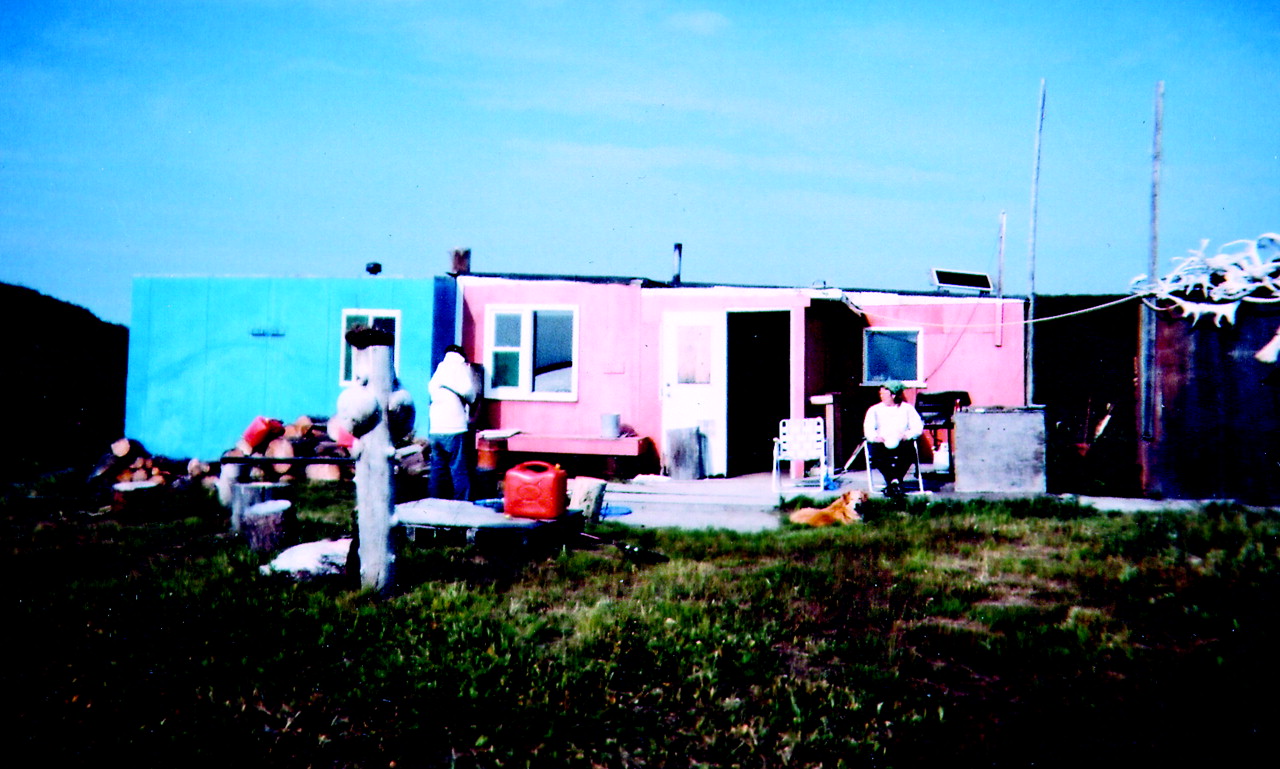
Culture
The land
Both boys shared their sentiments on conservation of nature: “I took this [photograph] because I like the scenery a lot, the trees. I think it’s really important that we keep the environment intact as much as we can.” The other explained, “It’s all about the land. We have all these huge oil companies coming up and I have a feeling it’s gonna rip apart our land. I just wanna show it while it’s still there” (Figure 2).

It’s all about the land
Nothing to do
Having “nothing to do” was seen as the biggest problem for youth in Inuvik: “I think it’s really good to have something to do, because when there’s nothing to do you end up doing bad stuff. Mindless sitting around outside the video store. You’ll see that around town a lot—just hanging out, no theatre, not too much to do a lot of the time.” Another stated, “There’s not much to do, and kids just turn to other alternatives: do drugs, alcohol, gambling” (Figure 3).
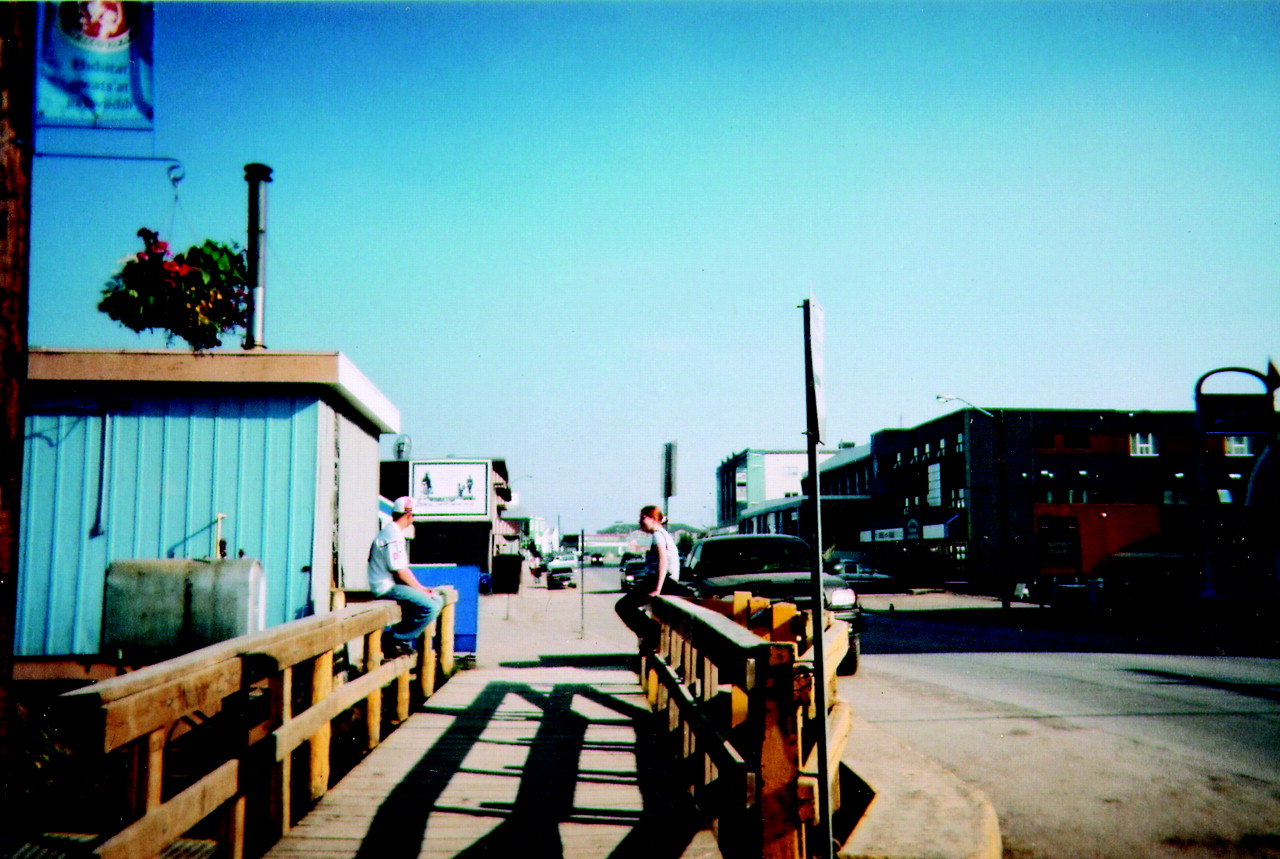
Nothing to do
Another thought the youth centre was “important to the community ‘cause it keeps kids out of trouble when they have something to do. Prevents vandalism and other reckless stuff.” She suggested “build[ing them] a bigger and better youth centre, with more things to do, maybe even a little theatre attached to it, because there is just not a whole lot to do if you’re not going out on the land or into sports. There’s not much for you here; it’s kind of depressing.”
Smoking
One girl took a photograph of cigarettes in an ashtray to represent a youth health issue: “A lot of people don’t have anything to do, so it’s hard to keep their minds off it, so they just keep smoking anyway. I think if kids are smart enough not to start it might help make things a bit easier. … I never personally ever smoked a cigarette in my life. I was on a committee against tobacco, representing the Northwest Territories, so I felt I had to hold a role in that way. I just think it’s gross, bad; but it’s a big problem, and a lot of youth smoke” (Figure 4).

Smoking
Alcohol and drug abuse
Both boys brought up substance abuse in discussing youth health issues: “We have a lot of people who do drugs; it’s just not right.” When asked why this happens, one responded, “Isolation, it’s just the way people think. Depression, trying to escape how they’re feeling. … I’ve just taken from my older brothers’ mistakes. I have 2 older brothers; I’ve seen them take drugs and alcohol. I’ve seen the effects on them, and I just didn’t want to get into it, didn’t seem right. They were losing a lot of money and it was just wearing them out, and I didn’t like that.“
The other boy discussed the effects of fetal alcohol syndrome: “A lot of the kids have FAS ‘cause their parents were drinking and they just don’t really care, and it’s really sad to see, so I’d say it’s a pretty big problem here.”
Teen pregnancy
The youths saw teen pregnancy as a common problem in Inuvik: “The majority of my childhood friends are pregnant, have had a kid, or had an abortion. There’s a lot of unwanted births where a kid just gets neglected. There’s nothing you can do unless you fine them for something like that, but that’s unlikely.” Similarly, one boy discussed its negative impact: “I guess it would be parents my age, shacking up and making a kid by accident, not wanting it so they don’t take care of it too well.”
Solutions
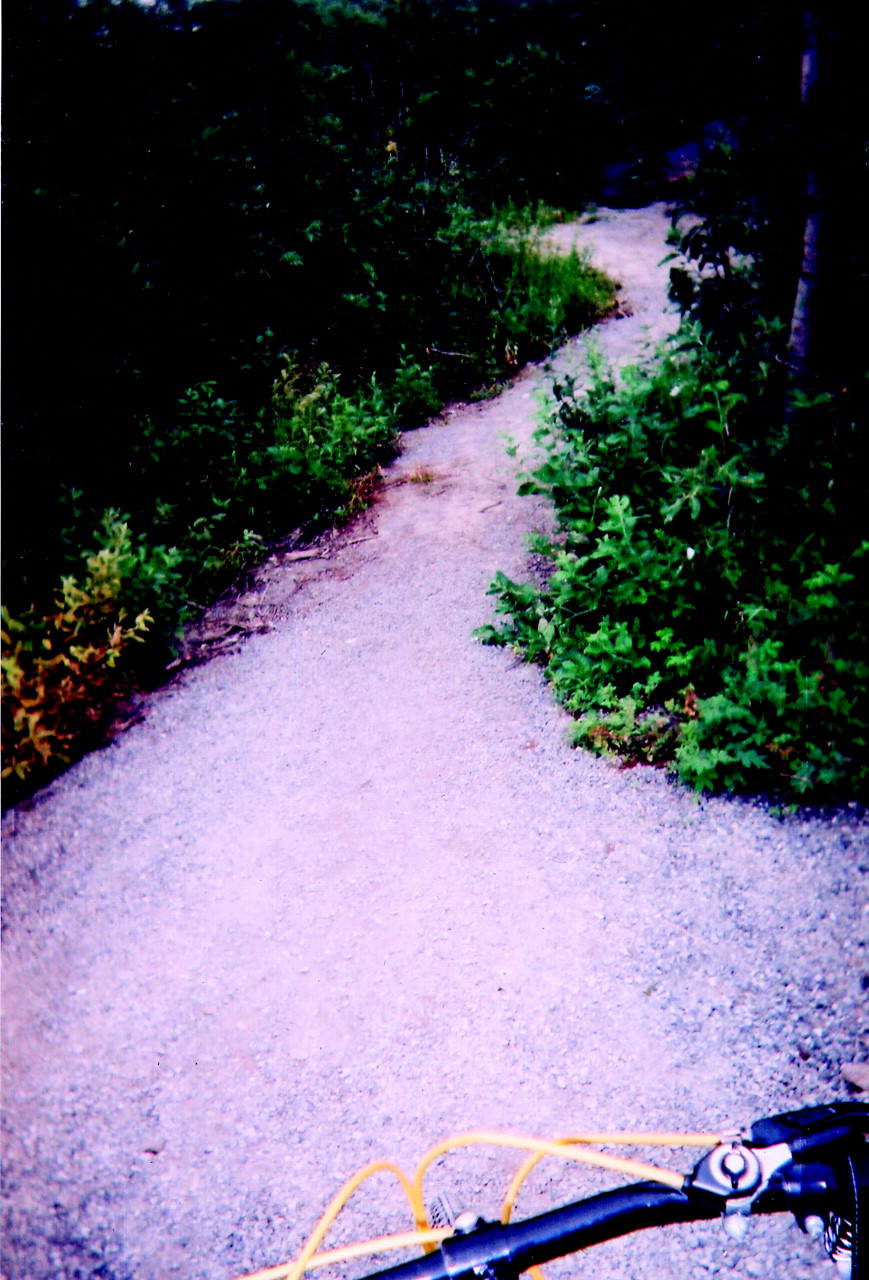
The existing skateboarding park was seen not merely as an element of youth culture but as an “important part of Inuvik.” One boy suggested “a better skate-park” was a potential solution to the youth problems in Inuvik (Figure 5).
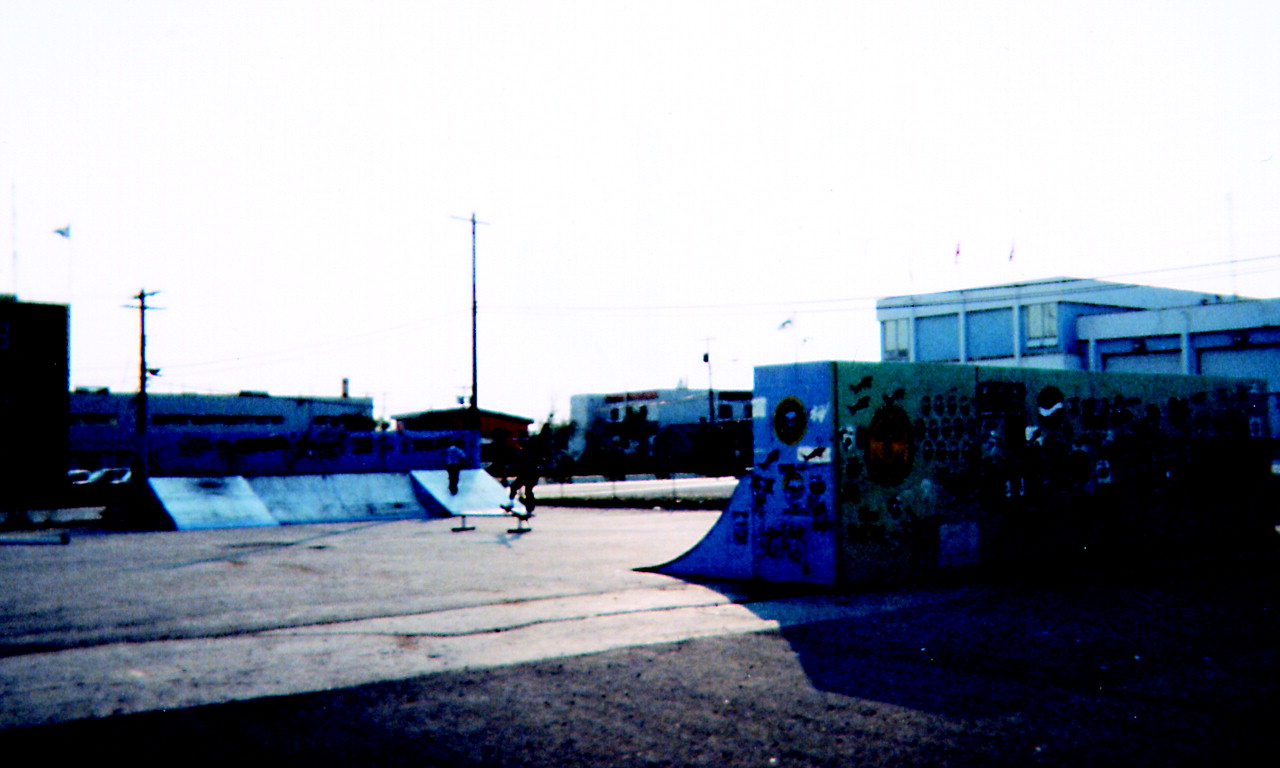
A better skatepark
The following ideas were also mentioned as potential solutions: “I think we need better education, better things offered to encourage [youth] to stay in school, because a lot of people don’t. As soon as you hit high school that’s when it really thins out. Talk to them more about what you can do with an education.”
“A peer group that does fun things together and supports each other to get out of a habit, maybe one for all habits. That way if someone goes out to a party and they see their peer friend, it’s like, ‘You can’t do that!’”
“Sports, games, get them involved in more stuff to knock them away from the drugs and alcohol.”
New hospital
When asked about the recently built hospital in Inuvik, the youths had differing opinions based on their personal experiences. One boy responded, “My great-grandma just recently passed away there in the new hospital. It’s a nice facility and they took good care of her there while she was alive. … I have a lot of respect for the staff there, hard-working people.”
In contrast, one girl alluded to the lack of diagnostic equipment at the hospital while speaking about her father’s death: “This is my dad’s grave. He passed away in January of this year. … He was diagnosed 11 months before he died. … After he passed away they did raise a whole bunch of money under his name to get some new medical supplies to detect colon cancer. He’s impacted the community a lot” (Figure 6).
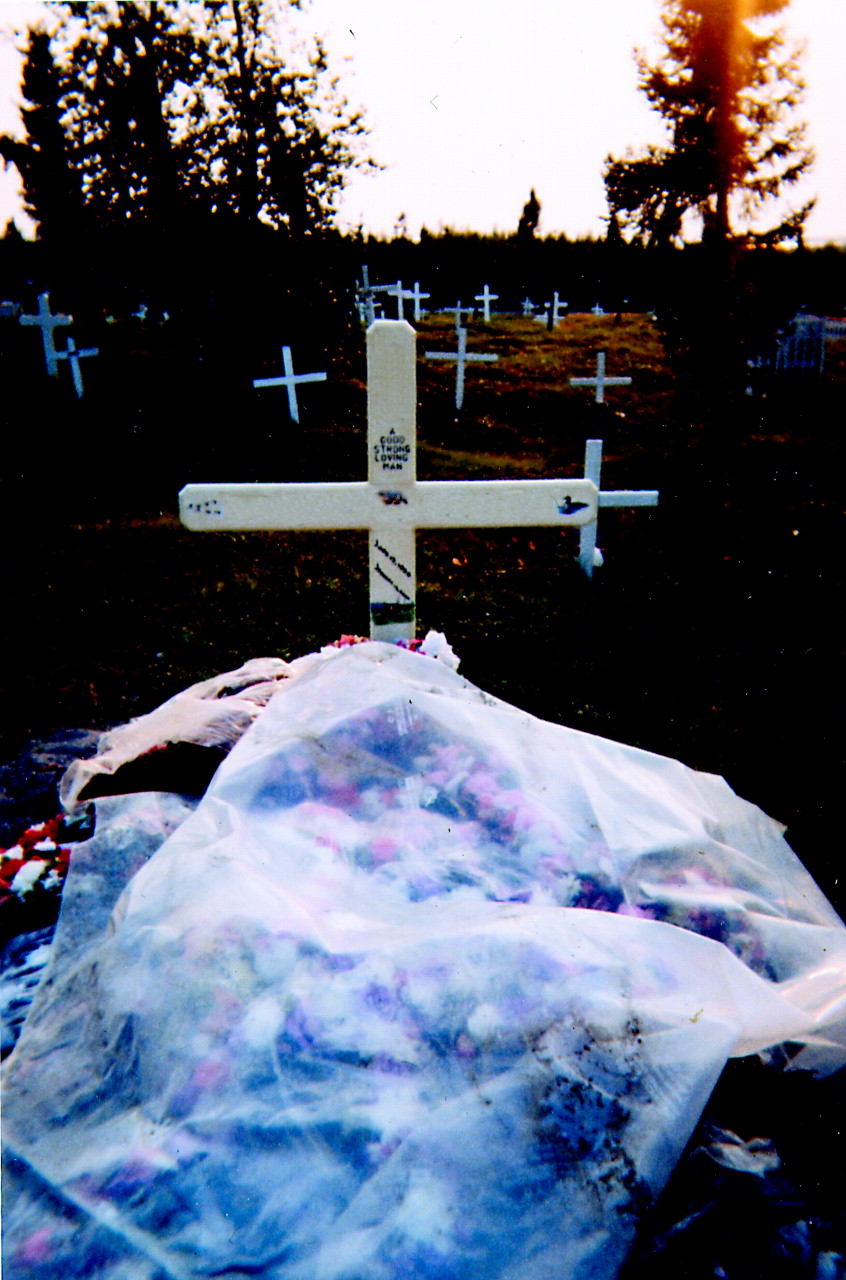
My dad’s grave
DISCUSSION
While suicide and solvent abuse are publicized in the media as problems affecting Inuit youth, neither issue was discussed as a health concern by any of the 14 Inuvik youths interviewed in this study. As Isaacs et al2 suggested, these problems affect the Inuit youth in the eastern NWT more than in the western NWT. This differentiation is important, as the 2 regions are lumped together by the media.
Inuvik youths voiced concerns about the same issues seen in urban youth clinics: smoking, alcohol and drug abuse, and teen pregnancy. Although they come from Inuvialuit and Gwich’in cultural backgrounds in a remote northern setting, they are strikingly similar to youth in Canadian cities.
According to the youths, boredom in Inuvik is an important cause of bad habits, like smoking and alcohol and drug abuse, due to the lack of facilities, such as a movie theatre or shopping mall, to occupy their time. The skatepark holds great value to the youth as a source of recreation and distraction from substance abuse; for instance, several youths suggested upgrades to the skate-park as part of the solution to youth health problems.
Handing out free disposable cameras was successful in recruiting youths, who are notoriously difficult to reach and engage, and talking about photographs was a good starting point for discussions with the youths about what was meaningful to them. This photonovella method can be applied to future research in adolescent health.
Sixty-three percent of the youths (22/35) in this study returned their cameras. This return rate was twice that found by photographer Amelie Breton, who handed out 10 disposable cameras to youths aged 16 to 20 in Inukjuak, Nunavik, and received 33% (3/10) of the cameras back.11 The greater reliability of the youths in Inuvik might represent differences between the western and eastern Arctic. Alternatively, Breton’s sample size might have been too small.
The 4 youths selected for the video shared exceptional achievements: one was the class valedictorian; another was the NWT representative at the Miss World Canada pageant; one was a former NWT representative on the national Youth Advisory Committee on tobacco issues (now the Youth Action Committee); and another was a winner of a civic hero medal for saving the life of a boy swimming in a local pool. Although these youths were excellent speakers, they were not representative of the average youth in the community and might not be able to speak on behalf of their peers. Their voiced health concerns and proposed solutions might not be shared by the larger population of youth in the western Arctic. It would be useful to repeat this study in other communities in the western NWT and to contrast the results with the eastern NWT before generalizing the findings to the Canadian Arctic. Another limitation of this study was that data analysis and theme development were conducted largely by the researcher alone.
CONCLUSION
The most prominent health concerns for Inuvik youth are smoking, alcohol and drug abuse, and teen pregnancy, not suicide or solvent abuse, which are well publicized but more prevalent in the eastern arctic. By having Inuvik youths share their photographs and stories, health professionals can gain insight into the perspectives of youth in northern communities and expand their capacities to heal. Photo novella is a promising research method in adolescent health.
Acknowledgment
I thank Drs Colleen Kirkham, Trevor Corneil, Ruth Elwood Martin, Betty Calam, and Morgan Price for their insightful contributions. I extend heartfelt thanks to the participating Inuvik youths who shared their photographs and stories. This work was supported by the Inuvialuit Community Corporation, Aurora Research Institute, Inuvik Youth Centre Society, and Inuvik Regional Hospital staff. I thank Ms Areta Wong for her help with formatting the manuscript. This study was funded by research grants from the Lloyd Jones Collins Foundation, the BC College of Family Physicians, and the University of British Columbia Family Practice Department.
Notes
EDITOR’S KEY POINTS
In photo novella, children and populations with little access to decision makers are given cameras and encouraged to take photographs of life as they see it. Photo novella enables community members to communicate about areas where they think change must occur.
Although suicide and solvent abuse are often publicized as problems affecting Inuit youth, neither of these issues was discussed as a health concern by the youths interviewed in this study.
The Inuvik youths expressed health concerns similar to those common in urban youth clinics: smoking, alcohol and drug abuse, and teen pregnancy.
POINTS DE REPÈRE DU RÉDACTEUR
Dans la technique des romans-photos, on distribue des appareils-photos à des enfants et à des personnes ayant peu d’influence sur les décideurs en les encourageant à faire des photos de la vie telle qu’ils la voient. Le roman-photo permet aux membres de la communauté de s’exprimer sur des sujets pour lesquels des changement s’imposent.
Même si on entend souvent parler de problèmes de suicide et d’abus de solvant chez les jeunes Inuit, aucune de ces questions n’a été abordée comme problème de santé par les jeunes interviewés dans cette étude.
Les inquiétudes exprimées par les jeunes d’Inuvik étaient semblables à celles qu’on rencontre fréquemment dans les cliniques urbaines pour jeunes: abus de tabac, d’alcool et de drogue et grossesse chez les adolescentes.
Footnotes
This article has been peer reviewed.
Competing interests
In this study, the author produced an educational video that now has a distributor through which she makes profits from the sales.
- Copyright© the College of Family Physicians of Canada
In this issue




Jump to section
Related Articles
Cited By...
- No citing articles found.