


ABSTRACT
PROBLEM BEING ADDRESSED Family physicians face innumerable challenges to delivering quality palliative home care to meet the complex needs of end-of-life patients and their families.
OBJECTIVE OF PROGRAM To implement a model of shared care to enhance family physicians’ ability to deliver quality palliative home care, particularly in a community-based setting.
PROGRAM DESCRIPTION Family physicians in 3 group practices (N = 21) in Ontario’s Niagara West region collaborated with an interprofessional palliative care team (including a palliative care advanced practice nurse, a palliative medicine physician, a bereavement counselor, a psychosocial-spiritual advisor, and a case manager) in a shared-care partnership to provide comprehensive palliative home care. Key features of the program included systematic and timely identification of end-of-life patients, needs assessments, symptom and psychosocial support interventions, regular communication between team members, and coordinated care guided by outcome-based assessment in the home. In addition, educational initiatives were provided to enhance family physicians’ knowledge and skills.
CONCLUSION Because of the program, participants reported improved communication, effective interprofessional collaboration, and the capacity to deliver palliative home care, 24 hours a day, 7 days a week, to end-of-life patients in the community.
While family physicians wish to remain active in the care of their dying patients,1 it can be a challenge to address the complex issues at the end of life (EOL).2–4 Additionally, family physicians often receive insufficient training in palliative care5–7 and experience difficulty in accessing specialist resources for support. Effective, sustainable models of palliative care that support optimal care and death at home can be achieved, however, when family physicians work in collaboration with interprofessional, specialist palliative care teams.8–13 In the United Kingdom, such models of care demonstrate improvement in all parameters of community-based care.12,14
Across the country, a number of service gaps continue to exist similar to those identified in previous publications (Table 1).15 There is an urgent need to develop a true shared-care model of interprofessional palliative home care to enable family physicians to provide effective care in the context of an aging population, a rising prevalence of cancer,16 chronic illness, and shortages of hospital-based resources. The focus of this paper is to describe the shared-care model that was created in the Niagara West region of Ontario (620 km2, 3 towns, and a total population of 80 000) and discuss the interventions and outcomes that pertain to family physicians and primary caregivers. Most patient outcomes are reported in a separate paper.
Service gaps in current practice
Program objectives and goals
The overall goal of the program was to enhance family physician capacity to deliver palliative home care through collaboration with interprofessional palliative care specialists in a shared-care model. Specifically, this goal entailed improving access to palliative care through the use of screening criteria and case finding in family practice offices; improving primary care physicians’ knowledge, skills, and confidence in providing palliative care through practice-based education and shared clinical care with palliative care experts; and improving the quality of palliative home care through specialist team enhancements.
Program description
The program involved 3 months of resource development, 15 months of service delivery, and 3 months of data analysis. The pre-existing West Lincoln Memorial Hospital Palliative Care Team, a part-time community team, expanded into the Enhanced Palliative Care Team (EPCT). Figure 1 illustrates the 4 key components of the care model, which are as follows:

Key components of the shared-care model for optimal palliative care
Enhanced and integrated teams
The EPCT included a full-time palliative care advanced practice nurse (APN), a part-time palliative medicine physician (PMP), a psychosocial-spiritual advisor, a bereavement counselor, and a full-time Community Care Access Centre (CCAC) case manager. Self-selected “Physician Practice Leaders” from each of the 3 family practice groups involved in the project were mentored by the EPCT in palliative care knowledge and skills and given support to attend training courses. The practice leaders, the APN, and the PMP all joined an on-call roster available to the community nurses and doctors 24 hours a day, 7 days a week, for advice during off hours. The APN was a “navigator” for communication between team members, clinical coordination of care, and overall patient care. The psychosocial-spiritual advisor provided counseling support, while the bereavement counselor provided bereavement risk assessment and support. The CCAC palliative care case manager was part of the team to ensure effective resource allocation consistent with care needs.
The APN, the bereavement counselor, and the psychosocial-spiritual advisor were funded by an Ontario Primary Health Care Transition Fund (PHCTF) grant (www.hc-sc.gc.ca/hcs-sss/prim/phctf-fassp/index_e.html). The CCAC covered the case manager’s salary, and the PMP continued in her previous fee-for-service model but received a stipend from the PHCTF for educational sessions with the participating family physicians. Stipends for the on-call roster were also supported by the PHCTF grant.
Access and assessment
Case finding and screening ensured that family physicians and patients received timely access to the EPCT. Using triage methods supported by health systems planners,17 the following screening questions were developed for the family physicians to consider:
-
Would you be surprised if this patient died in the next 12 months?
-
If no, does this patient have pain, symptom issues, or supportive care needs?
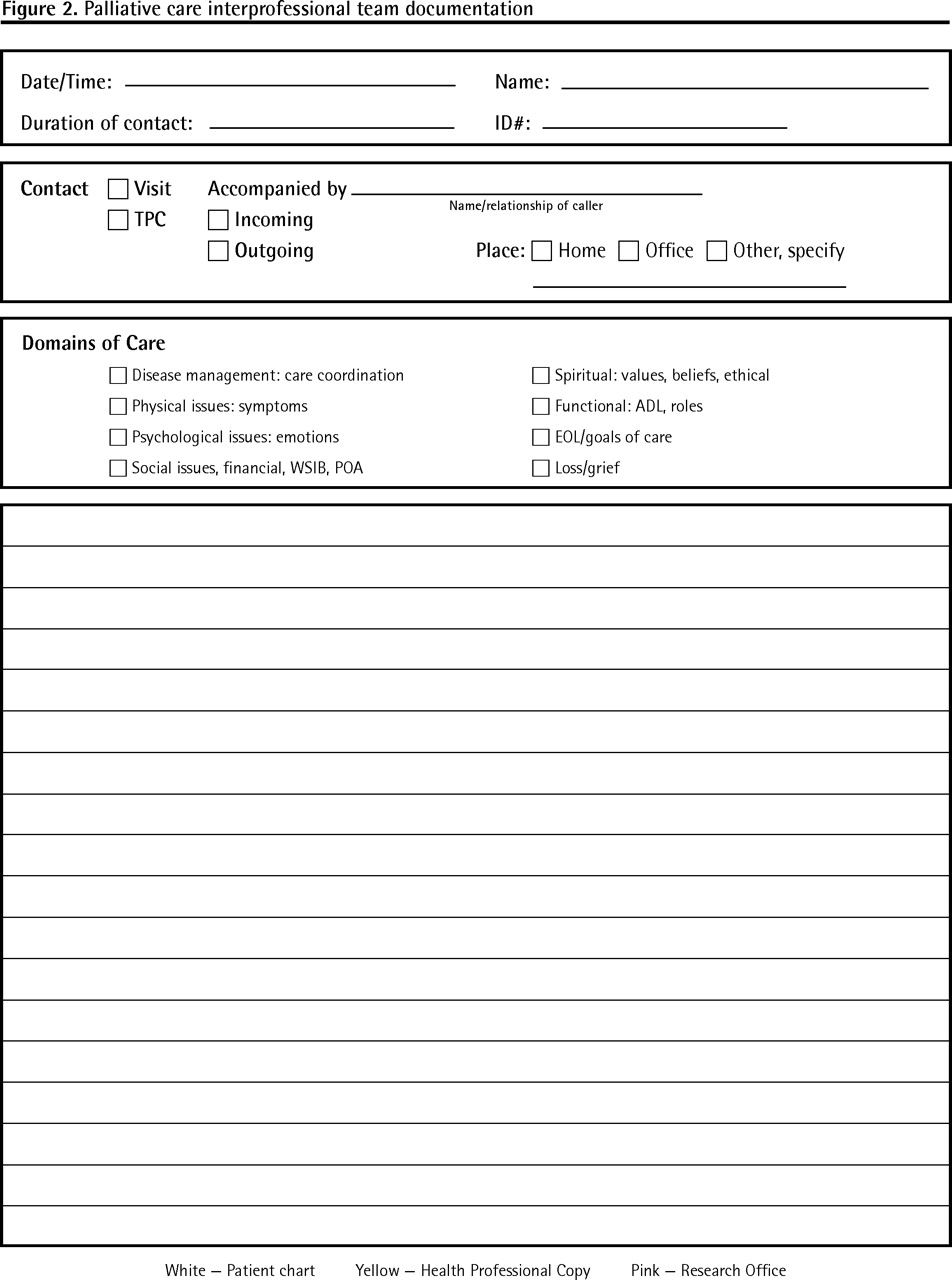
Family physicians and their staff were encouraged to refer patients who met these criteria to the shared-care team. The EPCT provided consultations and visits to the patients and families according to the needs expressed by the family doctors or community nurses. Care plans were made and implemented as a group. The EPCT involvement was flexible and was dictated by the needs of the patients, the families, and the family physicians. The family physicians remained the ones most responsible for their patients, with the EPCT involved as collaborators in care and second-line support. The family physicians could request any member of the EPCT for joint visits. A “case navigation” binder was created for each patient, for the patient to take home, and contained a list of contacts, clinical assessment schedules, and various assessment tools. The EPCT created and used an interprofessional documentation form (Figure 2) based on the “Square of Care”18 to assess patients’ needs and develop care plans that enabled all team members to contribute their expertise. Patient assessment tools included the Edmonton Symptom Assessment Scale,19 the Confusion Assessment Method,20 the Palliative Performance Scale,21 and the National Comprehensive Cancer Network’s patient and caregiver distress scale.22
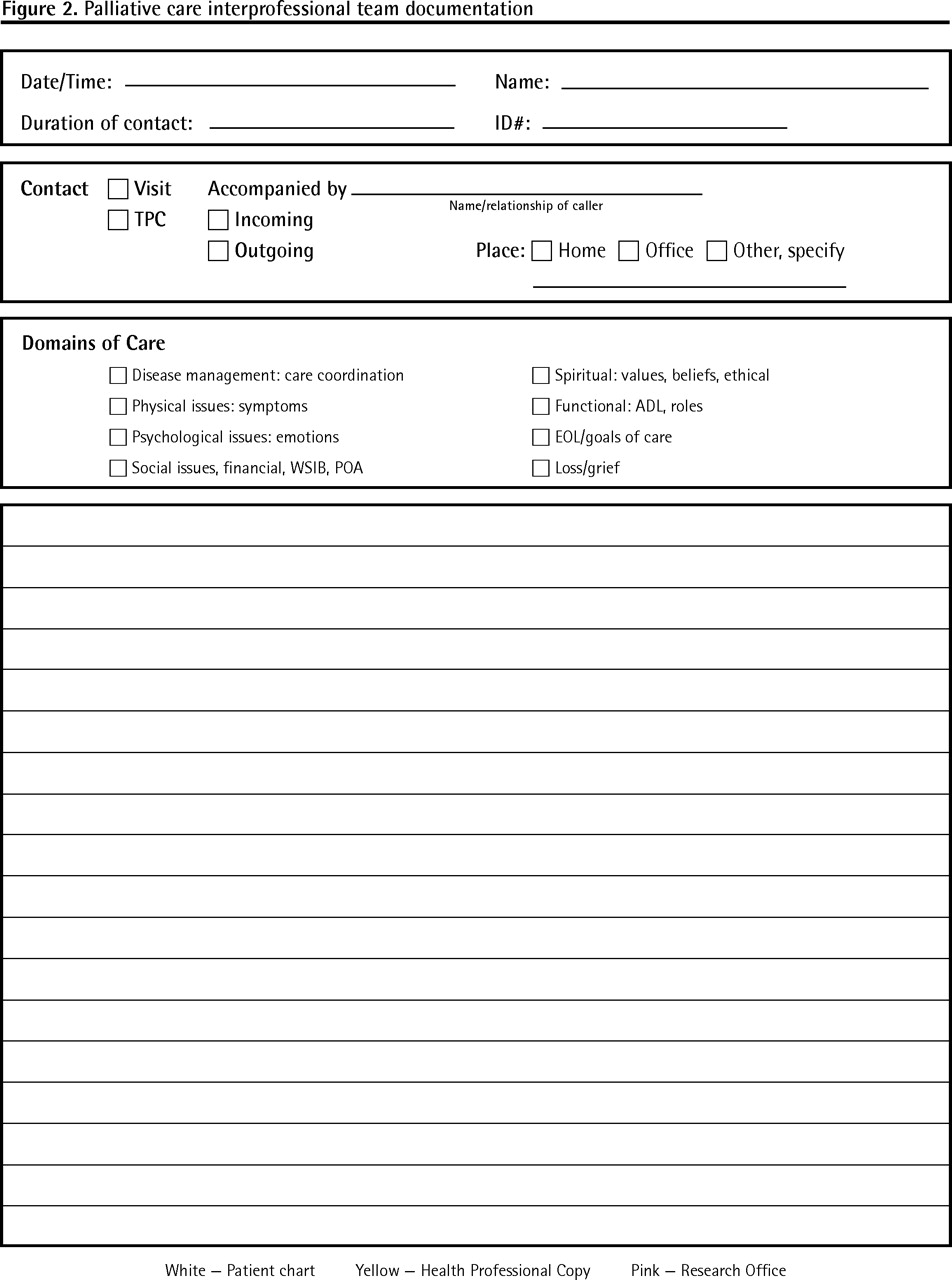
Palliative care interprofessional team documentation
Coordinated, continuous care
Communication between members of the EPCT and the family physicians was a priority. Referred patients were discussed at weekly EPCT meetings to ensure optimal documentation, communication, and coordination of care. The integration of family physicians as team members, using the APN as a link to family practice offices, and the communication mechanisms such as weekly updates to family physicians were critical elements of the model. The APN in particular was the key point of contact among the family physicians, patients, and families, and the other EPCT members across care settings. Strong foci for the APN included helping all providers with early symptom identification and leading clinical problem solving.
Education and decision support
The APN and the PMP identified educational needs of physicians and community nurses and coordinated practice-based, evidence-based strategies (“just in time” case-based teaching, chart reviews, academic detailing) to improve the knowledge, skills, and confidence required to deliver optimal care. Table 2 summarizes the topics covered during the 15 clinical and educational multidisciplinary sessions held in all 3 practices. These sessions were open to the physicians’ practice teams (nurses, pharmacists, students), the EPCT, and community nurses. The Physician Practice Leaders assumed leadership for these sessions as the project progressed.
Summary of topics covered
Results
The project recruited 100% of family physicians from 3 family health teams (N = 21) who, in a 12-month period, referred 114 patients to the EPCT for shared care. This represented a 40% increase in yearly referrals compared with referrals to the West Lincoln Memorial Hospital Palliative Care Team. Office chart reviews indicated 775 contacts made by the physicians: 236 office visits, 242 home visits, and 297 telephone calls or e-mails. Recipients of contact were predominately the EOL patients or their families (59%), followed by nurses (30%) and PMPs (5%). A total of 22 physicians and 36 nurses or other practice staff attended the 15 practice-based educational sessions during the project. Four physicians from the 3 practices elected to be Physician Practice Leaders. The on-call roster was used mostly on weekends, with calls from community nurses; on-call clinicians received an average of 1 to 2 calls per day. Most calls were to discuss escalation of symptoms or to obtain new orders or care plans. Actual visits to patients occurred less than once weekly (when on call).
Patients’ preferences for place of death were able to be accommodated much more frequently during this project. In total, 93% of the patients who expressed a preference for a place of death stated they wished to die at home; 59% of these patients did die at home, compared with 28% of palliative patients before the project. Mean length of patient participation in the program was 145.14 days (range 5 to 445 days). Sixty-six percent of patients referred to the project died by the end of the study period.
Provider perceptions of the project were evaluated through surveys, interviews, and focus groups. A survey was developed and mailed to the 21 physicians and 6 community nurses involved with the project to ascertain their views in 4 areas: roles and value of team members; team interaction; changes in practice; and effects on care quality. Of the 27 surveys sent, 4 nurses and 12 physicians replied, for a 60% response rate. Physicians felt that the most imperative component of the care model was having access to palliative care consultations around the clock. Practice-based education was felt to be the next most important component. Most physicians valued the personal contact with the EPCT. Physicians also felt that patients greatly benefited from access to a more comprehensive palliative home care team and from the coordinated, seamless integration of services. In general, physicians felt that the project improved quality, communication, coordination, continuity, and integration of care and allowed them to maintain their role as the primary care providers.
The community nurses most valued the improved trust and working relationships between themselves and family physicians, whom they now felt were more confident and available to discuss treatment plans. They also felt less alone in handling complex issues that arose in the home setting. Support from the APN enhanced their problem-solving skills, which in turn improved their confidence in decision making.
Five physicians also participated in a qualitative, semistructured telephone interview after the project, and 4 community nurses participated in a focus group guided by a semistructured interview. Audiotapes from interviews and focus groups were transcribed and themes were identified using content analysis techniques.23 These findings are summarized in Tables 3 and 4.
Themes from interviews with physician participants after the project
Themes from interviews with nurse participants after the project
Discussion
This study of the shared-care model established that family physicians can provide ongoing care to their palliative care patients and families if supported through integrated and collaborative models of shared, interprofessional, specialist palliative care. This is particularly useful for physicians in limited-support practice communities, such as large rural areas. The family physicians and the community nurses participating in this program felt more confident and capable with such supports. The APN appears critical to the facilitation of the shared-care process by modeling best practices, identifying patients early, and enhancing family physician and community nurse involvement. Presumably by enhancing the efficiency and quality of physicians’ time with EOL care patients, the EPCT truly supported the family physician and allowed them to be more effective in their work.
This study also demonstrated that a home-based, shared-care model can accommodate patients’ preferences for place of death more often than more traditional models. There was a strong sense from participants that a care model was finally in place that created confidence in communicating by knowing “who to call for what” and how to build capacity within their own system.
Some success of this project could be attributed to the previously established relationships between the pre-existing palliative care team and some family physicians. This situation might not be as readily generalizable to other communities, which is a limitation of the study.
Future direction
The model has great relevance to the primary health care transformation agenda, as it focuses on building and enhancing the capacity of family physicians to deliver effective primary palliative care and supports integrated interprofessional teams. It is now the care model exemplar for the Local Health Integration Network in the Niagara West region. Dissemination of the project indicates interest at a systems planning level for this model. Sustainability of such models, however, hinges on changes in policy and funding that will allow for partnerships in true shared-care models customized at the community level.
Conclusion
This project has demonstrated that willing family physicians can successfully deliver effective care to their palliative home care patients on a full-time basis if supported by a collaborative practice and integrated models of care delivery. All of the family physicians approached participated in the project and were willing to use best practice screening criteria to identify palliative care patients early on in the advanced disease and dying trajectory. The role of a small but accessible consultation team was invaluable, as it allowed the physicians to share the load, grow in skill, and maintain their important primary role in the care of the patients. High-quality EOL care in Canada is achievable with this shared-care model of palliative primary care.
Acknowledgment
The authors wish to thank the Ontario Ministry of Health Primary Health Care Transition Fund for funding this project; Bonnie Rush, Research Assistant, for the data analysis; Diane Gauthier, Administrative Coordinator in the Division of Palliative Care, for overall project coordination; members of the Niagara West Palliative Care Team from 2004 to 2007, and the family physicians, staff, and patients in Niagara West who thoughtfully participated in this project.
Notes
EDITOR’S KEY POINTS
-
Family physicians often wish to participate in the end-of-life care of their dying patients, but there are substantial challenges to the delivery of this complex care. This program aimed to enhance family physician capacity to deliver palliative home care through collaboration in an interprofessional shared-care model.
-
Specific goals of the program included improving access to palliative care through the use of screening criteria and case finding in family practice offices; improving primary care physicians’ knowledge, skills, and confidence in providing palliative care through practice-based education and shared clinical care with palliative care experts; and improving the quality of palliative home care through specialist team enhancements.
-
Physicians felt that the most helpful component of the program was having access to palliative care consultations around the clock. The community nurses most valued the improved trust and working relationships between themselves and family physicians. Both nurses and physicians felt increased confidence in their decision making.
-
Physicians felt that patients greatly benefited from access to a more comprehensive palliative home care team and from the coordinated, seamless integration of services. The program was also able to accommodate the patients’ preferences for place of death more often than more traditional models.
POINTS DE REPÈRE DU RéDACTEUR
-
Le médecin de famille désire souvent prendre part aux soins des patients en fin de vie, mais cette tâche complexe comporte d’importantes difficultés.. Ce programme a pour but d’améliorer la capacité du médecin de famille de prodiguer des soins palliatifs à domicile en collaborant avec une équipe interdisciplinaire de soins partagés.
-
Les buts spécifiques du programme sont entre autres: améliorer l’accès aux soins palliatifs en établissant des critères de dépistage et en dépistant les cas dans les bureaux de médecine familiale; améliorer les connaissances et les habiletés du médecin de première ligne, et sa confiance en sa capacité de prodiguer les soins palliatifs grâce à une formation fondée sur la pratique et en partageant les soins cliniques avec des experts en soins palliatifs; et améliorer la qualité des soins palliatifs à domicile grâce à l’appui de l’équipe de spécialistes.
-
L’accès en tout temps à des consultations en soins palliatifs était la composante la plus utile du programme d’après les médecins. Les infirmières communautaires privilégiaient une confiance accrue et de meilleures relations de travail avec les médecins de famille. Les infirmières comme les médecins se sentaient plus confiants pour prendre des décisions.
-
Les médecins croyaient que l’accès à une équipe élargie de soins palliatifs à domicile et à des services intégrés de façon transparente était grandement avantageux pour les patients. Le programme permettait aussi de respecter plus souvent que les modèles traditionnels le lieu où le patient désirait mourir.
Footnotes
-
*Full text is available in English at www.cfp.ca.
-
Cet article a fait l’objet d’une révision par des pairs.
-
This article has been peer reviewed.
-
Contributors
Drs Marshall, Howell, Brazil, Howard, and Taniguchi contributed to concept, design, and implementation of the program; data gathering, analysis, and interpretation; and preparing the manuscript for submission.
-
Competing interests
None declared
- Copyright© the College of Family Physicians of Canada
References
In this issue


Jump to section
Related Articles
Cited By...
- Oral health in cancer palliative care: cross-sectional study
- General practice palliative care: patient and carer expectations, advance care plans and place of death--a systematic review
- Family physicians supporting patients with palliative care needs within the Patient Medical Home in the community: An Appreciative Inquiry qualitative study
- Community-based specialist palliative care teams and health system costs at end of life: a retrospective matched cohort study
- Ultimate journey of the terminally ill: Ways and pathways of hope
- Impact of community based, specialist palliative care teams on hospitalisations and emergency department visits late in life and hospital deaths: a pooled analysis
- Exploring education and training needs among the palliative care workforce
- Factors supporting good partnership working between generalist and specialist palliative care services: a systematic review