Main menu

  • Home
  • Articles
    • Current
    • Published Ahead of Print
    • Archive
    • Supplemental Issues
    • Collections - French
    • Collections - English
  • Info for
    • Authors & Reviewers
    • Submit a Manuscript
    • Advertisers
    • Careers & Locums
    • Subscribers
    • Permissions
  • About CFP
    • About CFP
    • About the CFPC
    • Editorial Advisory Board
    • Terms of Use
    • Contact Us
    • CFP AI policy
  • Feedback
    • Feedback
    • Rapid Responses
    • Most Read
    • Most Cited
    • Email Alerts
  • Blogs
    • Latest Blogs
    • Blog Guidelines
    • Directives pour les blogues
  • Mainpro+ Credits
    • About Mainpro+
    • Member Login
    • Instructions
  • Other Publications
    • http://www.cfpc.ca/Canadianfamilyphysician/
    • https://www.cfpc.ca/Login/
    • Careers and Locums

User menu

  • My alerts

Search

  • Advanced search
The College of Family Physicians of Canada
  • Other Publications
    • http://www.cfpc.ca/Canadianfamilyphysician/
    • https://www.cfpc.ca/Login/
    • Careers and Locums
  • My alerts
The College of Family Physicians of Canada

Advanced Search

  • Home
  • Articles
    • Current
    • Published Ahead of Print
    • Archive
    • Supplemental Issues
    • Collections - French
    • Collections - English
  • Info for
    • Authors & Reviewers
    • Submit a Manuscript
    • Advertisers
    • Careers & Locums
    • Subscribers
    • Permissions
  • About CFP
    • About CFP
    • About the CFPC
    • Editorial Advisory Board
    • Terms of Use
    • Contact Us
    • CFP AI policy
  • Feedback
    • Feedback
    • Rapid Responses
    • Most Read
    • Most Cited
    • Email Alerts
  • Blogs
    • Latest Blogs
    • Blog Guidelines
    • Directives pour les blogues
  • Mainpro+ Credits
    • About Mainpro+
    • Member Login
    • Instructions
  • RSS feeds
  • Follow cfp Template on Twitter
  • LinkedIn
  • Instagram
Research ArticlePractice

Targeting success in heart failure

Evidence-based management

Adam B. Gruszczynski, Brenda Schuster, Loren Regier and Brent Jensen
Canadian Family Physician December 2010; 56 (12) 1313-1317;
Adam B. Gruszczynski
  • Find this author on Google Scholar
  • Find this author on PubMed
  • Search for this author on this site
Brenda Schuster
  • Find this author on Google Scholar
  • Find this author on PubMed
  • Search for this author on this site
Loren Regier
  • Find this author on Google Scholar
  • Find this author on PubMed
  • Search for this author on this site
  • For correspondence: regierl{at}rxfiles.ca
Brent Jensen
  • Find this author on Google Scholar
  • Find this author on PubMed
  • Search for this author on this site
  • Article
  • Figures & Data
  • eLetters
  • Info & Metrics
  • PDF
Loading

Heart failure (HF) is a common condition in primary care with 1% of the population self-reporting this condition. Mortality is substantial, approaching 40% to 50% over 5 years. Heart failure is a complex syndrome in which abnormal heart function results in, or increases the subsequent risk of, clinical symptoms and signs of low cardiac output or pulmonary or systemic congestion.1 This article will present some practical tips for managing HF.2

Case description

C.C. is a 67-year-old woman with a long history of dilated cardiomyopathy and chronic atrial fibrillation (since 1992), type 2 diabetes requiring insulin (since 1994), stage 3 chronic renal insufficiency (since 2005), and gastroesophageal reflux disease. She has an extensive list of medications: 160 mg of valsartan once daily; 10 mg of ramipril once daily; 40 mg of furosemide twice daily; 0.25 mg of digoxin once daily; 20 mg of atorvastatin once daily; 30 mg of nifedipine extended release once daily; 81 mg of acetylsalicylic acid once daily; 7.5 mg of warfarin once daily; 24 units of Novolin ge NPH in the morning, 30 units at supper; 10 units of Novolin ge Toronto in the morning, 5 units at night; 1000 mg of metformin twice daily; 150 mg of ranitidine once daily; 420 mg of magnesium oxide once daily; 500 mg of calcium carbonate once daily; and 300 mg of ferrous sulfate once daily.

After 16 years of stability, her lifestyle has deteriorated, with a poor diet and cessation of her cardiac rehabilitation exercise program. During 5 hospital admissions, 5 different cardiologists suggested differing treatment regimens, modifying doses or agents in the same class. Metabolic investigations reveal poor control of her diabetes, with a glycated hemoglobin A1c of 8.1%. Results of complete blood count and electrolyte measurement are normal, but her creatinine level is 160 mmol/L (estimated creatinine clearance 40 mL/min). Cardiac investigations reveal new triple-vessel coronary artery disease. She declines revascularization and wishes to be treated medically. Her atrial fibrillation is well controlled. Echocardiography shows systolic dysfunction with an ejection fraction between 18% and 28%. The cardiothoracic surgeon indicates that cardiac pacing or an implanted cardioverter defibrillator are not options for C.C. Her treatment is challenged by the family medicine resident who questions potential inconsistencies between her treatment regimen and HF management guidelines. The patient’s understanding of her condition is inadequate for her to comply effectively with lifestyle changes, and communication among her caregivers has been inadequate, given the complexity of her case.

Bringing evidence to practice

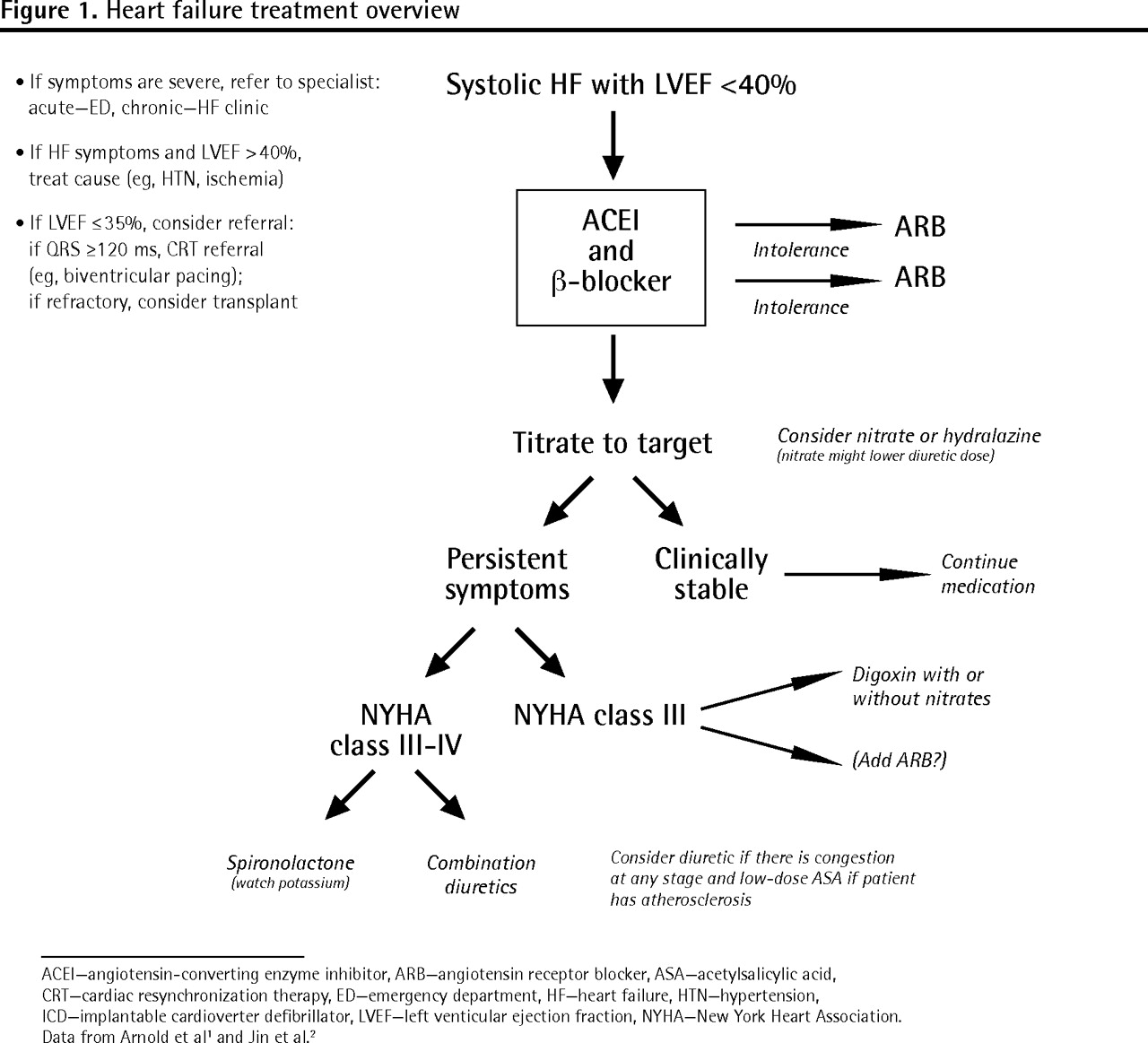
The management algorithm for chronic HF is summarized in Figure 1.2 Both aggressive use of medication to target doses and patient education are required for effective management of HF1; however, the foundation for all HF therapy includes nonpharmacologic management (Box 1).2
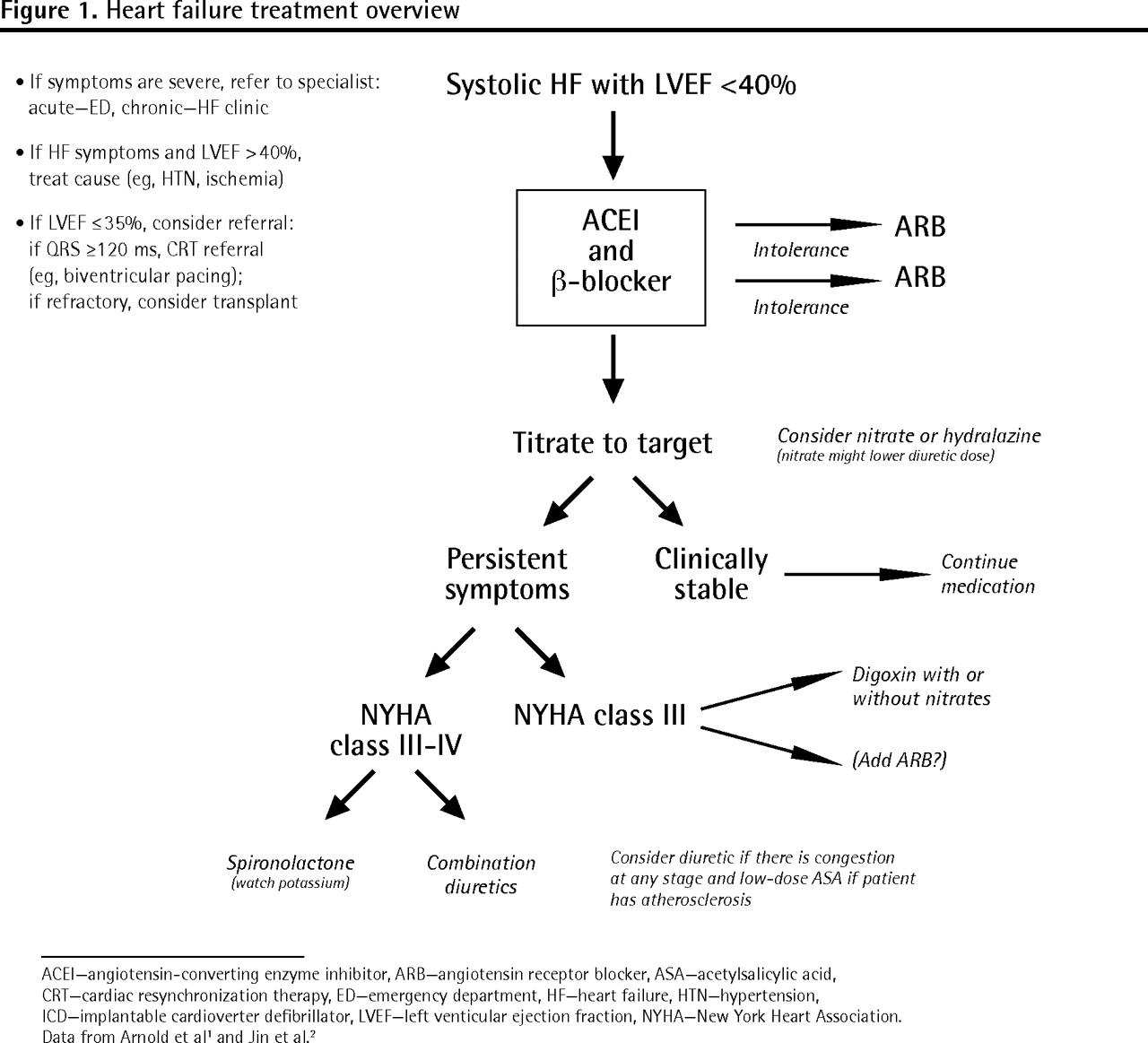
Figure 1.
  • Download figure
  • Open in new tab
Figure 1.

Heart failure treatment overview

ACEI—angiotensin-converting enzyme inhibitor, ARB—angiotensin receptor blocker, ASA—acetylsalicylic acid, CRT—cardiac resynchronization therapy, ED—emergency department, HF—heart failure, HTN—hypertension, ICD—implantable cardioverter defibrillator, LVEF—left venticular ejection fraction, NYHA—New York Heart Association.

Data from Arnold et al1 and Jin et al.2

Box 1.

Nonpharmacologic management of heart failure

  • Exercise (after stress test assessment)

  • No-added-salt diet (2 to 3 g of salt per day)

      (6 g salt ≈ 1 tsp salt ≈ 2400 mg sodium)

  • Daily morning weight (nude and after voiding)

  • Fluid intake 1.5 to 2 L per day

  • No more than 1 alcoholic drink per day

  • Smoking cessation

  • Influenza and pneumococcal vaccination

  • Data from Jin et al.2

  • Dietary, lifestyle, and over-the-counter nonsteroidal anti-inflammatory drug indiscretions are common sources of HF exacerbations.2,3 Lifestyle measures facilitate HF management. Communicating information about exercise and salt and fluid intake to patients is essential for optimal management.

    • The patient can exercise aerobically 3 to 5 times per week (30 to 40 minutes per session) for New York Heart Association class I to III HF.4

    • All patients need to restrict salt intake to 2 to 3 g (0.5 tsp) per day. Patients with unremitting fluid retention or advanced cardiac failure (ejection fraction less than 35%) require restriction to less than 2 g (eg, approximately 0.25 tsp) of salt per day.

    • Have patients report any weight gain of 2 lb (1 kg) in 1 to 2 days or 5 lb (2 kg) in 1 week. Selected patients might be suitable candidates to self-adjust their furosemide doses, doubling furosemide until normal weight is restored or holding furosemide if weight decreases by 1 kg.

    • Patients, especially those with renal dysfunction or hyponatremia, should restrict fluid intake to 1.5 to 2.0 L per day.

    Diuretics are useful in providing symptom relief, especially acutely, but do not prevent long-term mortality.3 Overreliance on diuretics often results in hypotension and electrolyte abnormalities, limiting the use of other agents that reduce mortality.

    • Loop diuretics are preferred for congestive symptoms. Once symptoms are relieved, use the lowest effective maintenance dose. Multiple daily dosing can be used to improve diuretic effect, especially if higher doses are needed.

    • If persistent volume overload continues with optimal furosemide therapy, add a low-dose thiazide diuretic or metolazone (most effective if given 30 minutes before furosemide).5 Remember to monitor daily weight and regularly measure creatinine, urea, potassium, and magnesium levels.

    • Spironolactone (12.5 to 25 mg) should be considered for patients with an ejection fraction of less than 30% and symptoms of HF.6 Although the target dose in the RALES (Randomized Aldactone Evaluation Study Investigators) trial was 50 mg, 25 mg daily was the average dose reached.6 Remember to watch out for hyperkalemia.

    • Isosorbide dinitrate or a nitroglycerin patch are additional options, especially for nocturnal dyspnea.

    While diuretics help symptoms, β-blockers (BBs) and angiotensin-converting enzyme inhibitors (ACEIs) have the best demonstrated evidence for mortality and morbidity outcomes in HF.7–9

    • The maximum tolerated target dose of ACEI should be used in all HF patients with ejection fractions of less than 40%1 (Table 1).2,3,10–16,* If ACEI intolerance develops, an angiotensin receptor blocker (ARB) can be used.13,17

    • Generally, ACEIs and ARBs should not be combined, as adverse effects increase with little extra benefit. Exceptions might include symptomatic patients with class III or IV HF on optimum ACEI and BB treatment, or those unable to tolerate BBs.2 Blood pressure, serum creatinine, and potassium should be monitored.

    • To titrate ACEIs or ARBs, start at low doses, then double the dose at 1- to 2-week intervals until the target dose is reached or until intolerable side effects persist. Trial evidence for best HF outcomes has been with relatively high doses.14,18

    • β-Blockers have strong evidence for mortality reduction.7 Initiate only if patients’ HF is stable and euvolemic. Start at low doses and double the dose every 2 to 4 weeks. Warn patients to expect some symptom worsening, initially.

    • When pursuing maximum tolerated doses of ACEIs or BBs, a heart rate as low as 50 beats per minute or a blood pressure as low as 80/50 mm Hg might not require any change in therapy, as long as the patient is not showing symptoms of hypotension (eg, dizziness and falls).

    View this table:
    • View inline
    • View popup
    Table 1.

    Heart failure drugs overview comparison chart

    Other agents can help if symptoms persist after maximizing the most beneficial agents.

    • Digoxin can be used to improve symptoms and decrease hospitalization if symptoms persist on optimal treatment, especially if the ejection fraction is less than 30% or for concomitant treatment of atrial fibrillation. The target blood level in HF is less than 1.3 nmol/L to prevent adverse events.19

    • Combination isosorbide dinitrate and hydralazine should be considered in addition to standard therapy for African Americans with systolic dysfunction20 and for HF patients unable to tolerate other standard treatment or who have chronic renal failure. A nitroglycerin patch can be substituted for oral nitrates. Remember to allow for a 12-hour nitrate-free period.

    While patient dietary indiscretions often occur, we must also be aware of prescriber indiscretions that can exacerbate HF. Specifically, medications such as nonsteroidal anti-inflammatory drugs, antiarrhythmic agents, diltiazem, verapamil, stimulants, glitazones, corticosteroids, tumor necrosis factor blockers, and numerous cancer chemotherapeutic agents are implicated.1,3

    Case resolution

    Steps are taken to improve C.C.’s treatment regimen. The first step is communication with her HF clinic physician, who agrees to be the primary consultant for cardiac therapy changes. She participates in an intense educational program on HF. In the year after her therapy is changed, C.C. avoids any admission to the hospital for HF. Her medications are adjusted and better reflect the evidence-based treatment guidelines: 10 mg of ramipril once daily; 10 mg of bisoprolol once daily; 0.125 mg of digoxin once daily; 25 mg of spironolactone once daily; 80 mg of furosemide twice daily; 2.5 mg of metolazone on Monday, Wednesday, and Friday; 420 mg of magnesium oxide once daily; 60 mg of isosorbide mononitrate at bedtime; 600 mg of Slow K once daily; 5 mg of warfarin once daily; 40 mg of atorvastatin once daily; 81 mg of acetylsalicylic acid once daily; 40 units of Novolin ge NPH twice daily; 24 units of Novolin ge Toronto 3 times daily; 20 mg of rabeprazole once daily; 1000 IU of vitamin D once daily; 300 mg of ferrous sulfate once daily; and 500 mg of calcium carbonate once daily. Metformin, which had been held during periods of acute congestion, was restarted at 500 mg twice daily, in line with current recommendations.3

    Important concepts in management of chronic HF are summarized in Box 2.2 Educating patients on lifestyle measures supports medication management. Ensuring patients approach the maximal tolerated target doses for ACEIs and BBs improves mortality and morbidity. Adhering to the targets of treatment, combined with patient education and communication between family physicians, cardiologists, pharmacists, and dietitians, will lessen the burden of this disease on patients, caregivers, and the health care system.

    Box 2.

    Pearls for decreased morbidity and mortality in HF

    • Patient education is key (consider referral to an interprofessional HF clinic where available)

    • Make sure all patients with reduced ejection fraction are on the maximum tolerated dose of BB and ACEI (or ARB)

    • After HF is controlled, titrate BB dose gradually (every 2 to 4 weeks); patient will feel worse before feeling better; ACEI dose should be titrated every 1 to 2 weeks

    • To optimize ACEI and BB dose, decrease dose of diuretics, nitrates, and other antihypertensives

    • Consider adding a third drug (eg, spironolactone, digoxin, nitrate) if the patient is still symptomatic on ACEI and BB

    • Ensure ongoing communication among health care providers

  • ACEI—angiotensin-converting enzyme inhibitor, ARB—angiotensin receptor blocker BB—β-blocker, HF—heart failure.

  • Data from Jin et al.2

  • Notes

    RxFiles is an academic detailing program providing objective comparative drug information. RxFiles incorporates information from family physicians, other specialists, and pharmacists with an extensive review of the literature to produce newsletters, question-and-answer summaries, trial summaries, and drug comparison charts. The RxFiles Drug Comparison Charts book and website have become practical tools for evidence-based and clinically relevant drug use information throughout Canada. For more information, go to www.RxFiles.ca.

    Footnotes

    • ↵* The full version of the RxFiles heart failure overview and treatment chart is available at www.cfp.ca. Go to the full text of the article online, then click on CFPlus in the menu at the top right-hand side of the page.

    • Competing interests

      RxFiles and contributing authors do not have any commercial competing interests. RxFiles Academic Detailing Program is funded through a grant from Saskatchewan Health to Saskatoon Health Region; additional “not for profit; not for loss” revenue is obtained from sales of books and online subscriptions.

    • Copyright© the College of Family Physicians of Canada

    References

    1. 1.↵
      1. Arnold JM,
      2. Liu P,
      3. Demers C,
      4. Dorian P,
      5. Giannetti N,
      6. Haddad H,
      7. et al
      . Canadian Cardiovascular Society Consensus Conference recommendations on heart failure 2006: diagnosis & management. Can J Cardiol 2006;22(1):23-45.
      OpenUrlCrossRefPubMed
    2. 2.↵
      1. Jin M,
      2. Jensen B,
      3. Regier L
      . Heart failure treatment overview and chart. RxFiles drug comparison charts. 8th ed. Saskatoon, SK: Saskatoon Health Region; 2010. Available from: www.rxfiles.ca/rxfiles/uploads/documents/members/cht-Heart-Failure.pdf. Accessed 2010 Oct 11.
    3. 3.↵
      1. Arnold JM,
      2. Howlett JG,
      3. Dorian P,
      4. Ducharme A,
      5. Giannetti N,
      6. Haddad H,
      7. et al
      . Canadian Cardiovascular Society Consensus Conference recommendations on heart failure update 2007: prevention, management during intercurrent illness or acute decompensation, and the use of biomarkers. Can J Cardiol 2007;23(1):21-45.
      OpenUrlPubMed
    4. 4.↵
      1. O’Connor CM,
      2. Whellan DJ,
      3. Lee KL,
      4. Keteyian SJ,
      5. Cooper LS,
      6. Ellis SJ,
      7. et al
      . Efficacy and safety of exercise training in patients with chronic heart failure: HF-ACTION controlled trial. JAMA 2009;301(14):1439-50.
      OpenUrlCrossRefPubMed
    5. 5.↵
      1. Lorenz RA,
      2. Elwell RJ
      . Pre-dosing metolazone with loop diuretic combination regimens. Nephrol Nurs J 2006;33(1):78-9.
      OpenUrlPubMed
    6. 6.↵
      1. Pitt B,
      2. Zannad F,
      3. Remme WJ,
      4. Cody R,
      5. Castaigne A,
      6. Perez A,
      7. et al
      . The effect of spironolactone on morbidity and mortality in patients with severe heart failure. Randomized Aldactone Evaluation Study Investigators (RALES). N Engl J Med 1999;341(10):709-17.
      OpenUrlCrossRefPubMed
    7. 7.↵
      1. Shibata MC,
      2. Flather MD,
      3. Wang D
      . Systemic review of the impact of beta blockers on mortality and hospital admissions in heart failure. Eur J Heart Fail 2001;3(3):351-7.
      OpenUrlCrossRefPubMed
    8. 8.
      1. Flather MD,
      2. Yusuf S,
      3. Køber L,
      4. Pfeffer M,
      5. Hall A,
      6. Murray G,
      7. et al
      . Long-term ACE-inhibitor therapy in patients with heart failure or left-ventricular dysfunction: a systematic overview of data from individual patients. ACE-Inhinbitor Myocardial Infarction Collaborative Group. Lancet 2000;355(9215):1575-81.
      OpenUrlCrossRefPubMed
    9. 9.↵
      1. Fonarow GC,
      2. Abraham WT,
      3. Albert NM,
      4. Stough WG,
      5. Gheorghiade M,
      6. Greenberg BH,
      7. et al.,
      8. OPTIMIZE-HF Investigators and Coordinators
      . Influence of beta-blocker continuation or withdrawal in patients hospitalized with decompensated heart failure: findings from the OPTIMIZE-HF program. J Am Coll Cardiol 2008;52(3):190-9.
      OpenUrlCrossRefPubMed
    10. 10.↵
      1. Packer M,
      2. Coats AJ,
      3. Fowler MB,
      4. Katus HA,
      5. Krum H,
      6. Mohacsi P,
      7. et al.,
      8. Carvedilol Prospective Randomized Cumulative Survival Study Group
      . Effect of carvedilol on survival in severe chronic heart failure (COPERNICUS). N Engl J Med 2001;344(22):1651-8.
      OpenUrlCrossRefPubMed
    11. 11.↵
      The Cardiac Insufficiency Bisoprolol Study II (CIBIS-II): a randomised trial. Lancet 1999;353(9146):9-13.
      OpenUrlCrossRefPubMed
    12. 12.↵
      1. MERIT-HF Study Group
      . Effect of metoprolol CR/XL in chronic heart failure: Metoprolol CR/XL Randomised Intervention Trial in Congestive Heart Failure (MERIT-HF). Lancet 1999;353(9169):2001-7.
      OpenUrlCrossRefPubMed
    13. 13.↵
      1. Cohn JN,
      2. Tognoni G,
      3. Valsartan Heart Failure Trial Investigators
      . A randomized trial of the angiotensin-receptor blocker valsartan in chronic heart failure. N Engl J Med 2001;345(23):1667-75.
      OpenUrlCrossRefPubMed
    14. 14.↵
      1. Packer M,
      2. Poole-Wilson PA,
      3. Armstrong PW,
      4. Cleland JG,
      5. Horowitz JD,
      6. Massie BM,
      7. et al
      . Comparative effects of low and high doses of the angiotensin-converting enzyme inhibitor, lisinopril, on morbidity and mortality in chronic heart failure. ATLAS Study Group. Circulation 1999;100(23):2312-8.
      OpenUrlAbstract/FREE Full Text
    15. 15.↵
      1. Yusuf S,
      2. Teo KK,
      3. Pogue J,
      4. Dyal L,
      5. Copland I,
      6. Schumacher H,
      7. et al
      . Telmisartan, ramipril, or both in patients at high risk for vascular events (ONTARGET). N Engl J Med 2008;358(15):1547-59.
      OpenUrlCrossRefPubMed
    16. 16.↵
      1. McMurray JJ,
      2. Ostergren J,
      3. Swedberg K,
      4. Granger CB,
      5. Held P,
      6. Michelson EL,
      7. et al.,
      8. CHARM Investigators and Committees
      . Effects of candesartan in patients with chronic heart failure and reduced left-ventricular systolic function taking angiotensin-converting-enzyme inhibitors: the CHARM-Added trial. Lancet 2003;362(9386):767-71.
      OpenUrlCrossRefPubMed
    17. 17.↵
      1. Granger CB,
      2. McMurray JJ,
      3. Yusuf S,
      4. Held P,
      5. Michelson EL,
      6. Olofsson B,
      7. et al.,
      8. CHARM Investigators and Committees
      . Effects of candesartan in patients with chronic heart failure and reduced left-ventricular systolic function intolerant to angiotensin-converting-enzyme inhibitors: the CHARM-Alternative trial. Lancet 2003;362(9386):772-6.
      OpenUrlCrossRefPubMed
    18. 18.↵
      1. Regier LD,
      2. Jensen B
      . Angiotensin-converting enzyme inhibitors and angiotensin-receptor blockers in chronic heart failure. Ann Intern Med 2005;142(5):388.
      OpenUrlPubMed
    19. 19.↵
      1. Rathore SS,
      2. Curtis JP,
      3. Wang Y,
      4. Bristow MR,
      5. Krumholz HM
      . Association of serum digoxin concentration and outcomes in patients with heart failure. DIG study. JAMA 2003;289(7):871-8.
      OpenUrlCrossRefPubMed
    20. 20.↵
      1. Taylor AL,
      2. Ziesche S,
      3. Yancy C,
      4. Carson P,
      5. D’Agostino R Jr.,
      6. Ferdinand K,
      7. et al.,
      8. African-American Heart Failure Trial Investigators
      . Combination of isosorbide dinitrate and hydralazine in blacks with heart failure (A-HeFT). N Engl J Med 2004;351(20):2049-57. Epub 2004 Nov 8.
      OpenUrlCrossRefPubMed
    PreviousNext
    Back to top

    In this issue

    Canadian Family Physician: 56 (12)
    Canadian Family Physician
    Vol. 56, Issue 12
    1 Dec 2010
    • Table of Contents
    • About the Cover
    • Index by author
    Print
    Download PDF
    Article Alerts
    Sign In to Email Alerts with your Email Address
    Email Article

    Thank you for your interest in spreading the word on The College of Family Physicians of Canada.

    NOTE: We only request your email address so that the person you are recommending the page to knows that you wanted them to see it, and that it is not junk mail. We do not capture any email address.

    Enter multiple addresses on separate lines or separate them with commas.
    Targeting success in heart failure
    (Your Name) has sent you a message from The College of Family Physicians of Canada
    (Your Name) thought you would like to see the The College of Family Physicians of Canada web site.
    CAPTCHA
    This question is for testing whether or not you are a human visitor and to prevent automated spam submissions.
    Citation Tools
    Targeting success in heart failure
    Adam B. Gruszczynski, Brenda Schuster, Loren Regier, Brent Jensen
    Canadian Family Physician Dec 2010, 56 (12) 1313-1317;

    Citation Manager Formats

    • BibTeX
    • Bookends
    • EasyBib
    • EndNote (tagged)
    • EndNote 8 (xml)
    • Medlars
    • Mendeley
    • Papers
    • RefWorks Tagged
    • Ref Manager
    • RIS
    • Zotero
    Respond to this article
    Share
    Targeting success in heart failure
    Adam B. Gruszczynski, Brenda Schuster, Loren Regier, Brent Jensen
    Canadian Family Physician Dec 2010, 56 (12) 1313-1317;
    Twitter logo Facebook logo Mendeley logo
    • Tweet Widget
    • Facebook Like
    • Google Plus One

    Jump to section

    • Article
      • Case description
      • Bringing evidence to practice
      • Case resolution
      • Notes
      • Footnotes
      • References
    • Figures & Data
    • eLetters
    • Info & Metrics
    • PDF

    Related Articles

    • No related articles found.
    • PubMed
    • Google Scholar

    Cited By...

    • No citing articles found.
    • Google Scholar

    More in this TOC Section

    Practice

    • Determining if and how older patients can safely stay at home with additional services
    • Managing type 2 diabetes in primary care during COVID-19
    • Effectiveness of dermoscopy in skin cancer diagnosis
    Show more Practice

    RxFiles

    • How to help patients navigate genitourinary syndrome of menopause
    • Clinical pearls for management of migraines
    • Perles cliniques sur la prise en charge des migraines
    Show more RxFiles

    Similar Articles

    Navigate

    • Home
    • Current Issue
    • Archive
    • Collections - English
    • Collections - Française

    For Authors

    • Authors and Reviewers
    • Submit a Manuscript
    • Permissions
    • Terms of Use

    General Information

    • About CFP
    • About the CFPC
    • Advertisers
    • Careers & Locums
    • Editorial Advisory Board
    • Subscribers

    Journal Services

    • Email Alerts
    • Twitter
    • LinkedIn
    • Instagram
    • RSS Feeds

    Copyright © 2025 by The College of Family Physicians of Canada

    Powered by HighWire