
Main menu

  • Home
  • Articles
    • Current
    • Published Ahead of Print
    • Archive
    • Supplemental Issues
    • Collections - French
    • Collections - English
  • Info for
    • Authors & Reviewers
    • Submit a Manuscript
    • Advertisers
    • Careers & Locums
    • Subscribers
    • Permissions
  • About CFP
    • About CFP
    • About the CFPC
    • Editorial Advisory Board
    • Terms of Use
    • Contact Us
    • CFP AI policy
  • Feedback
    • Feedback
    • Rapid Responses
    • Most Read
    • Most Cited
    • Email Alerts
  • Blogs
    • Latest Blogs
    • Blog Guidelines
    • Directives pour les blogues
  • Mainpro+ Credits
    • About Mainpro+
    • Member Login
    • Instructions
  • Other Publications
    • http://www.cfpc.ca/Canadianfamilyphysician/
    • https://www.cfpc.ca/Login/
    • Careers and Locums

User menu

  • My alerts

Search

  • Advanced search
The College of Family Physicians of Canada
  • Other Publications
    • http://www.cfpc.ca/Canadianfamilyphysician/
    • https://www.cfpc.ca/Login/
    • Careers and Locums
  • My alerts
The College of Family Physicians of Canada

Advanced Search

  • Home
  • Articles
    • Current
    • Published Ahead of Print
    • Archive
    • Supplemental Issues
    • Collections - French
    • Collections - English
  • Info for
    • Authors & Reviewers
    • Submit a Manuscript
    • Advertisers
    • Careers & Locums
    • Subscribers
    • Permissions
  • About CFP
    • About CFP
    • About the CFPC
    • Editorial Advisory Board
    • Terms of Use
    • Contact Us
    • CFP AI policy
  • Feedback
    • Feedback
    • Rapid Responses
    • Most Read
    • Most Cited
    • Email Alerts
  • Blogs
    • Latest Blogs
    • Blog Guidelines
    • Directives pour les blogues
  • Mainpro+ Credits
    • About Mainpro+
    • Member Login
    • Instructions
  • RSS feeds
  • Follow cfp Template on Twitter
  • LinkedIn
  • Instagram
Research ArticleResearch

Physical activity assessment and counseling in Quebec family medicine groups

Aurélie Baillot, Jean-Patrice Baillargeon, Alex Paré, Thomas G. Poder, Christine Brown and Marie-France Langlois
Canadian Family Physician May 2018; 64 (5) e234-e241;
Aurélie Baillot
Professor in the Department of Nursing at the Université du Québec en Outaouais in Gatineau, and a researcher in the Institut du Savoir Montfort–Recherche in Ottawa, Ont.
PhD
  • Find this author on Google Scholar
  • Find this author on PubMed
  • Search for this author on this site
  • For correspondence: aurelie.baillot{at}uqo.ca
Jean-Patrice Baillargeon
Investigator in the Centre de recherche du Centre hospitalier universitaire de Sherbrooke (CHUS) in Quebec, an endocrinologist in the Centre intégré universitaire de santé et de services sociaux (CIUSSS) de l’Estrie–CHUS in Sherbrooke, and Professor in the Department of Medicine in the Division of Endocrinology at the University of Sherbrooke.
MD MSc
  • Find this author on Google Scholar
  • Find this author on PubMed
  • Search for this author on this site
Alex Paré
Research Coordinator in the Centre de recherche du CHUS and the CIUSSS de l’Estrie–CHUS.
MA
  • Find this author on Google Scholar
  • Find this author on PubMed
  • Search for this author on this site
Thomas G. Poder
Investigator in the Centre de recherche du CHUS and the CIUSSS de l’Estrie–CHUS, and Adjunct Professor in the Department of Family Medicine and Emergency Medicine at the University of Sherbrooke.
PhD
  • Find this author on Google Scholar
  • Find this author on PubMed
  • Search for this author on this site
Christine Brown
Research Coordinator in the Centre de recherche du CHUS and the CIUSSS de l’Estrie–CHUS.
MA
  • Find this author on Google Scholar
  • Find this author on PubMed
  • Search for this author on this site
Marie-France Langlois
Researcher in the Centre de recherche du CHUS, an endocrinologist in the CIUSSS de l’Estrie–CHUS, and Professor in the Department of Medicine in the Division of Endocrinology at the University of Sherbrooke.
MD FRCPC CSPQ
  • Find this author on Google Scholar
  • Find this author on PubMed
  • Search for this author on this site
  • Article
  • Figures & Data
  • eLetters
  • Info & Metrics
  • PDF
Loading

Article Figures & Data

Figures

  • Tables
  • Figure 1.
    • Download figure
    • Open in new tab
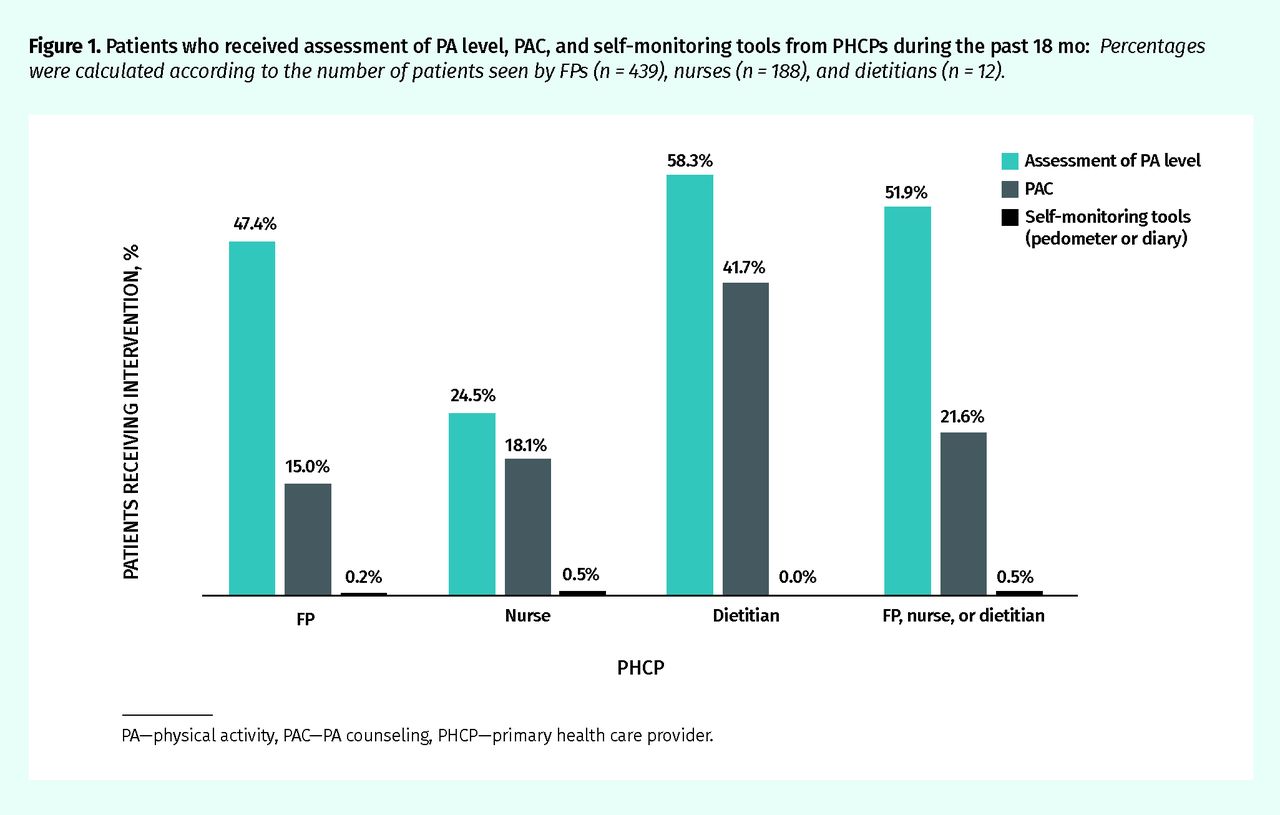
    Figure 1.

    Patients who received assessment of PA level, PAC, and self-monitoring tools from PHCPs during the past 18 mo: Percentages were calculated according to the number of patients seen by FPs (n = 439), nurses (n = 188), and dietitians (n = 12).

    PA—physical activity, PAC—PA counseling, PHCP—primary health care provider.
Tables

  • Figures
    • View popup
    Table 1.

    Patient characteristics and assessment of PA level and PAC provided by FPs, nurses, or dietitians during the past 18 mo: Variables in bold were included in the multivariate analysis as independent variables.

    CHARACTERISTICNVALUEPA LEVEL ASSESSMENTPAC
    OR (95% CI)P VALUEOR (95% CI)P VALUE
    Sociodemographic data
      • Female sex, %43966.10.90 (0.61 to 1.34).601.08 (0.67 to 1.75).76
      • Median age (IQR), y43959.1 (49.3 to 67.2)1.00 (0.98 to 1.01).620.99 (0.98 to 1.01).38
      • Married or in a civil union, %43967.21.08 (0.72 to 1.60).720.90 (0.55 to 1.45).65
      • Postsecondary education, %43732.31.08 (0.72 to 1.60).720.74 (0.45 to 1.23).25
      • Family annual income ≥ $55 000, %42940.60.98 (0.67 to 1.45).930.57 (0.35 to 0.93).03
      • Smoker, %43914.41.10 (0.64 to 1.88).730.93 (0.48 to 1.80).83
      • Private health coverage, %43956.01.05 (0.72 to 1.53).810.84 (0.53 to 1.32).45
      • Employed, %43942.11.30 (0.89 to 1.90).181.39 (0.88 to 2.19).16
    Anthropometric data
      • Median BMI (IQR), kg/m243928.7 (25.5 to 32.6)0.99 (0.96 to 1.02).401.08 (1.04 to 1.12)< .01
      • Median waist circumference (IQR), cm42496.4 (85.3 to 106.0)0.99 (0.98 to 1.01).221.03 (1.01 to 1.04)< .01
      • Overweight or obese (BMI ≥ 25 kg/m2), %43978.80.73 (0.46 to 1.16).182.39 (1.22 to 4.70)*.01
    Median no. of health provider encounters in past 18 mo (IQR)
      • Nurse4390 (0 to 2)1.17 (1.07 to 1.29)< .0011.26 (1.15 to 1.37)< .01
      • FP4394 (2 to 6)1.04 (0.97 to 1.11).311.07 (0.99 to 1.16).08
    Comorbidities
      • Hypertension43935.51.27 (0.886 to 1.88).231.79 (1.13 to 2.84).01†
      • Dyslipidemia43934.40.87 (0.59 to 1.30).491.53 (0.96 to 2.43).08†
      • Hypothyroidism43916.40.75 (0.45 to 1.24).260.77 (0.40 to 1.47).42
      • Sleep apnea4393.40.80 (0.29 to 2.23).681.86 (0.62 to 5.57).27
      • Osteoporosis4396.61.34 (0.62 to 2.87).460.74 (0.28 to 2.00).55
      • Anxiety or depression43917.81.51 (0.92 to 2.48).11†1.43 (0.82 to 2.51).21
      • Asthma or COPD43911.81.00 (0.56 to 1.78).990.73 (0.34 to 1.56).42
      • Arthritis or arthrosis43925.31.18 (0.76 to 1.81).461.23 (0.74 to 2.05).43
      • Heart and vascular disease43915.91.28 (0.77 to 2.15).340.99 (0.53 to 1.48).96
      • Type 2 diabetes or prediabetes43920.51.51 (0.94 to 2.42).09†3.50 (2.11 to 5.81)‡<.01†
      • Median no. of comorbidities (IQR)4392 (1 to 3)1.08 (0.95 to 1.21).241.23 (1.06 to 1.42)< .01
    Median health-related quality of life scores (IQR)
      • Physical component summary43548.8 (41.7 to 55.9)1.01 (1.00 to 1.03).161.02 (1.00 to 1.04).12
      • Mental component summary43551.2 (42.3 to 56.6)1.02 (1.00 to 1.04).041.00 (0.97 to 1.02).77
    Physical fitness and activity
      • Median recreational PA index score (IQR), kcal/kg/d4391.3 (0.5 to 2.5)1.13 (1.00 to 1.26).040.94 (0.82 to 1.08).38
      • Inactive, %43955.60.75 (0.52 to 1.10).141.26 (0.79 to 2.00).33
      • Television viewing > 20 h/wk, %43917.51.04 (0.94 to 1.12).441.04 (0.92 to 1.19).53
      • Median grip strength (IQR), kg43729.5 (22.5 to 39.0)1.00 (0.98 to 1.01).660.99 (0.97 to 1.01).31
      • Median isometric quadriceps strength (IQR), kg43623.5 (17.6 to 30.5)1.00 (0.98 to 1.02).791.02 (0.99 to 1.04).15
      • Median 6-min walk test distance (IQR), m351500.0 (428.5 to 560.0)1.00 (1.00 to 1.00).121.00 (1.00 to 1.00).43
    • BMI—body mass index, COPD—chronic obstructive pulmonary disease, IQR—interquartile range, OR—odds ratio, PA—physical activity, PAC—PA counseling.

    • ↵* Significantly more overweight or obese patients received PAC compared with patients who were not overweight or obese (24.3% vs 11.8%, P = .01).

    • ↵† These variables were included in the second multivariate analysis model instead of no. of comorbidities.

    • ↵‡ Significantly more patients with diabetes received PAC compared with patients who did not have diabetes (41.0% v. 16.6%, P < .001).

    • View popup
    Table 2.

    Associations between FP and FMG characteristics and the assessment of PA level and PAC provided by FPs, nurses, or dietitians during the past 18 mo: PAC performed by at least 1 PHCP was significantly associated with the assessment of PA level performed by at least 1 PHCP (OR [95% CI] 5.05 [2.93 to 8.72], P < .01). Variables in bold were included in the multivariate analysis as independent variables.

    CHARACTERISTICSPA LEVEL ASSESSMENTPAC
    OR (95% CI)P VALUEOR (95% CI)P VALUE
    FPs
      • Female sex2.37 (1.60 to 3.51)< .011.54 (0.95 to 2.48).08
      • Age0.97 (0.95 to 0.99).010.97 (0.95 to 0.99).01
      • Experience0.97 (0.96 to 0.99).010.97 (0.95 to 0.99)< .01
      • PA knowledge1.02 (1.01 to 1.04).011.00 (0.99 to 1.02).79
      • PAC self-efficacy1.01 (1.00 to 1.02).041.00 (0.99 to 1.01).35
      • Identity of the FP1.00 (0.99 to 1.02).550.99 (0.97 to 1.01).21
    FMGs
      • Leaflets on PA0.54 (0.29 to 1.00).050.83 (0.42 to 1.67).61
      • Canadian PA guidelines1.21 (0.83 to 1.77).311.31 (0.83 to 2.07).24
      • Pedometer used0.82 (0.42 to 1.60).560.80 (0.34 to 1.88).62
      • Effect of FMG0.95 (0.89 to 1.01).110.93 (0.86 to 1.01).08
    • FMG—family medicine group, OR—odds ratio, PA—physical activity, PAC—PA counseling, PHCP—primary health care provider.

    • View popup
    Table 3.

    Multivariate analysis to explain the assessment of PA provided by FPs, nurses, or dietitians during the past 18 mo: Nagelkerke R2 = 0.20; N = 339 patients.

    CHARACTERISTICMODEL 1
    OR (95% CI)P VALUE
    FP experience0.96 (0.94 to 1.00).002
    FP female sex2.70 (1.61 to 4.50)< .001
    Nurse encounters1.26 (1.12 to 1.43)< .001
    Physical component summary1.03 (1.00 to 1.05).03
    Mental component summary1.03 (1.00 to 1.05).04
    • OR—odds ratio, PA—physical activity.

    • View popup
    Table 4.

    Multivariate analysis to explain provision of PAC by FPs, nurses, or dietitians during the past 18 mo: In model 2, the no. of comorbidities was replaced by the comorbidities significantly associated with the dependent variables. Nagelkerke R2 = 0.31 for model 1; Nagelkerke R2 = 0.34 for model 2; N = 418 patients.

    CHARACTERISTICMODEL 1MODEL 2
    OR (95% CI)P VALUEOR (95% CI)P VALUE
    Assessment of PA performed by PHCPs4.40 (2.35 to 7.44)< .014.32 (2.37 to 7.85)< .01
    FP experience0.97 (0.94 to 0.99).010.97 (0.94 to 0.99).01
    Family annual income ≥ $55 0000.53 (0.31 to 0.92).030.56 (0.32 to 0.97).04
    Overweight or obese status4.20 (1.93 to 9.06)< .013.21 (1.46 to 7.12)< .01
    Nurse encounters1.24 (1.12 to 1.37)< .011.22 (1.10 to 1.35)< .01
    Physical component summary*1.06 (1.02 to 1.09)< .011.06 (1.03 to 1.10)< .01
    Type 2 diabetes or prediabetes*NANA2.84 (1.51 to 5.37)< .01
    • NA—not applicable, OR—odds ratio, PA—physical activity, PAC—PA counseling, PHCP—primary health care provider.

    • ↵* In model 2, type 2 diabetes or prediabetes status appeared before physical component summary score.

PreviousNext
Back to top

In this issue

Canadian Family Physician: 64 (5)
Canadian Family Physician
Vol. 64, Issue 5
1 May 2018
  • Table of Contents
  • About the Cover
  • Index by author
Print
Download PDF
Article Alerts
Sign In to Email Alerts with your Email Address
Email Article

Thank you for your interest in spreading the word on The College of Family Physicians of Canada.

NOTE: We only request your email address so that the person you are recommending the page to knows that you wanted them to see it, and that it is not junk mail. We do not capture any email address.

Enter multiple addresses on separate lines or separate them with commas.
Physical activity assessment and counseling in Quebec family medicine groups
(Your Name) has sent you a message from The College of Family Physicians of Canada
(Your Name) thought you would like to see the The College of Family Physicians of Canada web site.
CAPTCHA
This question is for testing whether or not you are a human visitor and to prevent automated spam submissions.
Citation Tools
Physical activity assessment and counseling in Quebec family medicine groups
Aurélie Baillot, Jean-Patrice Baillargeon, Alex Paré, Thomas G. Poder, Christine Brown, Marie-France Langlois
Canadian Family Physician May 2018, 64 (5) e234-e241;

Citation Manager Formats

  • BibTeX
  • Bookends
  • EasyBib
  • EndNote (tagged)
  • EndNote 8 (xml)
  • Medlars
  • Mendeley
  • Papers
  • RefWorks Tagged
  • Ref Manager
  • RIS
  • Zotero
Respond to this article
Share
Physical activity assessment and counseling in Quebec family medicine groups
Aurélie Baillot, Jean-Patrice Baillargeon, Alex Paré, Thomas G. Poder, Christine Brown, Marie-France Langlois
Canadian Family Physician May 2018, 64 (5) e234-e241;
Twitter logo Facebook logo Mendeley logo
  • Tweet Widget
  • Facebook Like
  • Google Plus One

Jump to section

  • Article
    • Abstract
    • METHODS
    • RESULTS
    • DISCUSSION
    • Conclusion
    • Notes
    • Footnotes
    • References
  • Figures & Data
  • eLetters
  • Info & Metrics
  • PDF

Related Articles

  • No related articles found.
  • PubMed
  • Google Scholar

Cited By...

  • Promotion of Physical Activity by Health Professionals (PROMOTE-PA): protocol for effectiveness outcomes in a hybrid type I effectiveness-implementation cluster randomised controlled trial
  • Integration of exercise professionals to help patients adopt and maintain healthy movement behaviour: What are we waiting for?
  • Intégration des professionnels en exercice pour aider les patients à adopter et maintenir un comportement de saine mobilité: Quattendons-nous?
  • Delivering brief physical activity interventions in primary care: a systematic review
  • Google Scholar

More in this TOC Section

  • Author ordering and citation-based measures of scholarly impact
  • Social and health determinants of wait times for primary care in Canada
  • Retaining family physicians in comprehensive primary care
Show more Research

Similar Articles

Subjects

  • Collection française
    • Résumés de recherche

Navigate

  • Home
  • Current Issue
  • Archive
  • Collections - English
  • Collections - Française

For Authors

  • Authors and Reviewers
  • Submit a Manuscript
  • Permissions
  • Terms of Use

General Information

  • About CFP
  • About the CFPC
  • Advertisers
  • Careers & Locums
  • Editorial Advisory Board
  • Subscribers

Journal Services

  • Email Alerts
  • Twitter
  • LinkedIn
  • Instagram
  • RSS Feeds

Copyright © 2025 by The College of Family Physicians of Canada

Powered by HighWire